+971 58 695 3885cvijanovic.aleksart@gmail.com@cvijanovic.aleksart
Aleksandra Cvijanović
From the studio

Journal

New work, exhibitions and notes from Aleksandra's studio in Dubai.

The Mask: This ain't a road

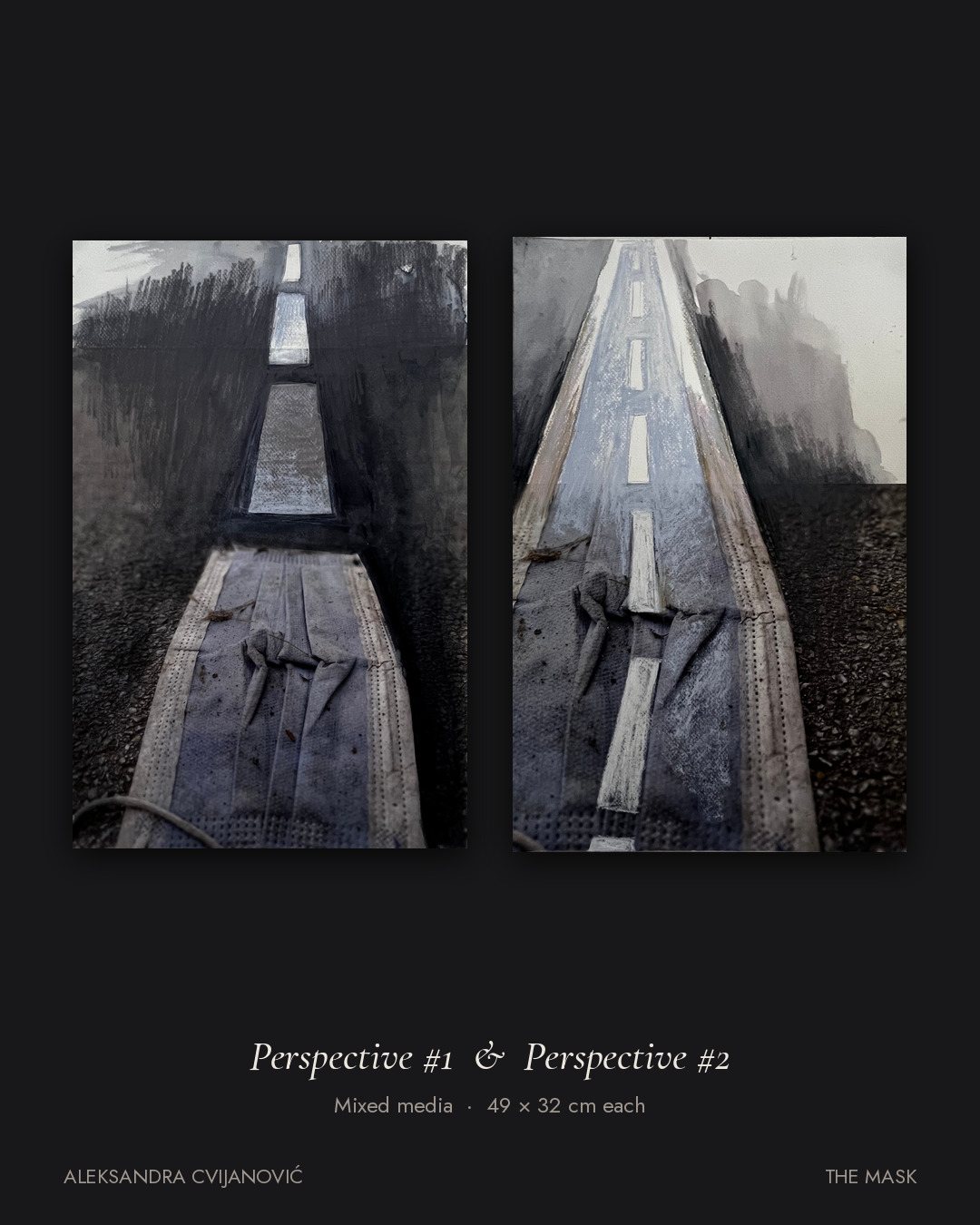
This ain't a road.

Look closer. Perspective #1 and Perspective #2 are two roads made from discarded surgical masks, enhanced with acrylic detail. The pleats become the asphalt, and the white lines run on into the distance.

We wore them to protect one another, and then we threw them away. Millions now lie in streets, parks, rivers and oceans. The Mask asks us to reconsider every object we use and throw away.

See both works in person at DIFC Art Nights, Gate Village, 12–15 November, 5–10 pm. Hit the road, and find the wall.

The whole series: cvijanovicaleks.art/difc-art-nights

Perspective #1 · Perspective #2 · The Mask · Mixed media · 49 × 32 cm each

For inquiries: cvijanovic.aleksart@gmail.com · cvijanovicaleks.art

The Mask · The Forest

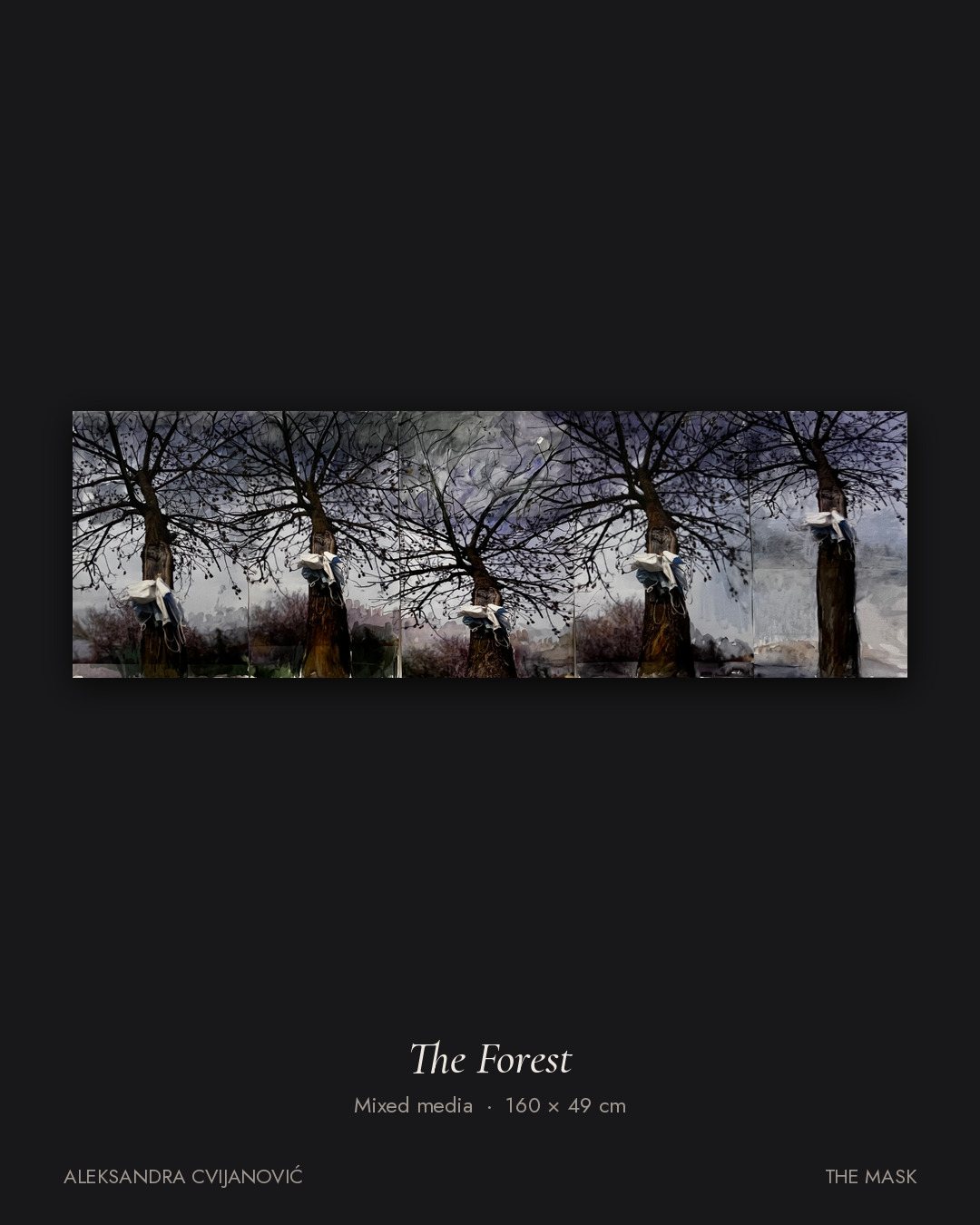
The Forest.

Five bare trees stand in a row against a dusk sky, their branches spreading into a dense black web. On every trunk hangs a bundle of used masks, white and blue, tied on like an offering, or left behind like litter.

At 160 cm wide it is the widest work in The Mask. Like every work in the series, it starts from a scene of abandoned masks and is finished with acrylic detail. What do we throw away, and where does it end up?

Six works from The Mask are on the wall at DIFC Art Nights, Gate Village, 12–15 November. The whole series, The Forest included, is at cvijanovicaleks.art/difc-art-nights

The Forest, from The Mask. Mixed media, 160 × 49 cm.

For inquiries: cvijanovic.aleksart@gmail.com · cvijanovicaleks.art

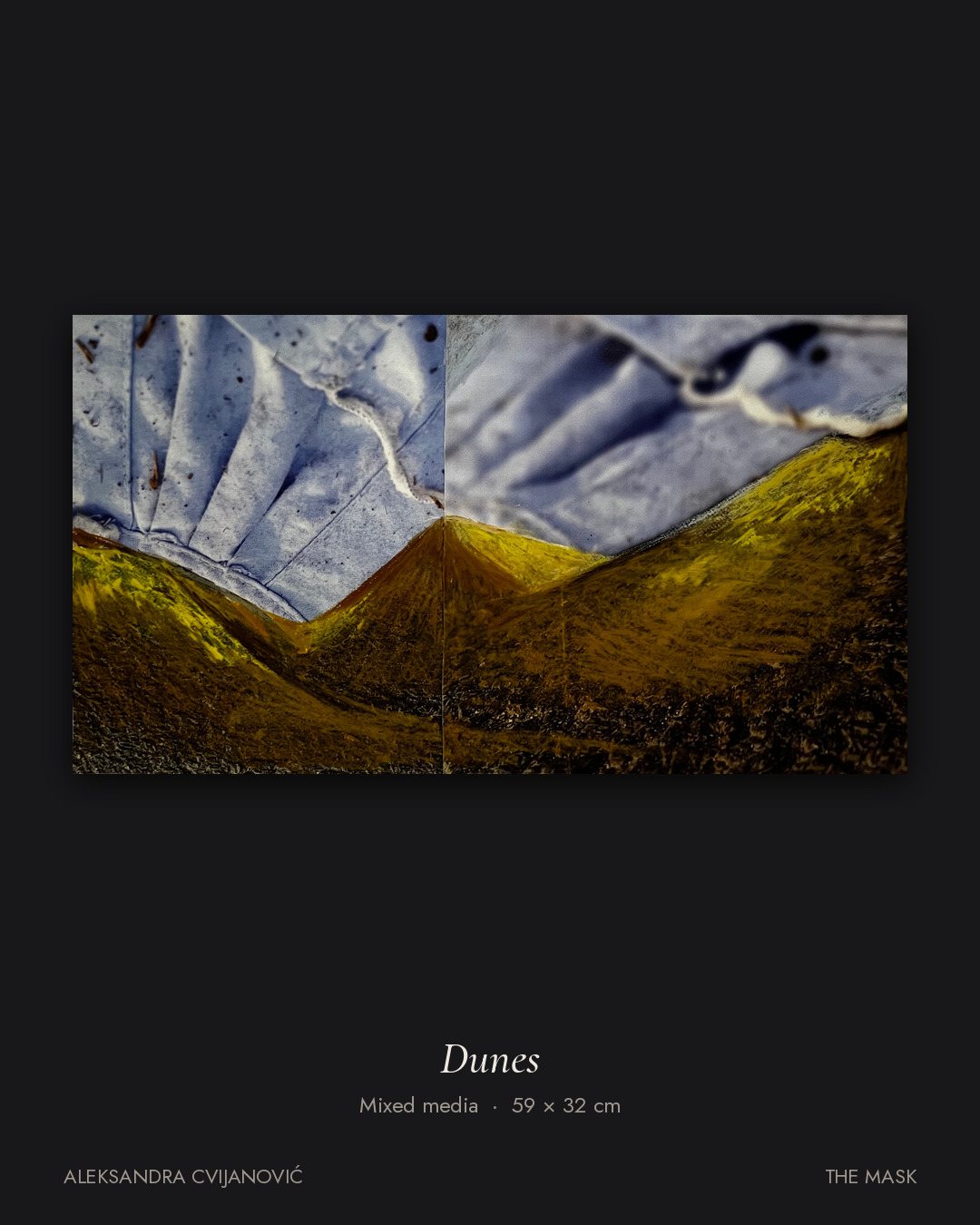
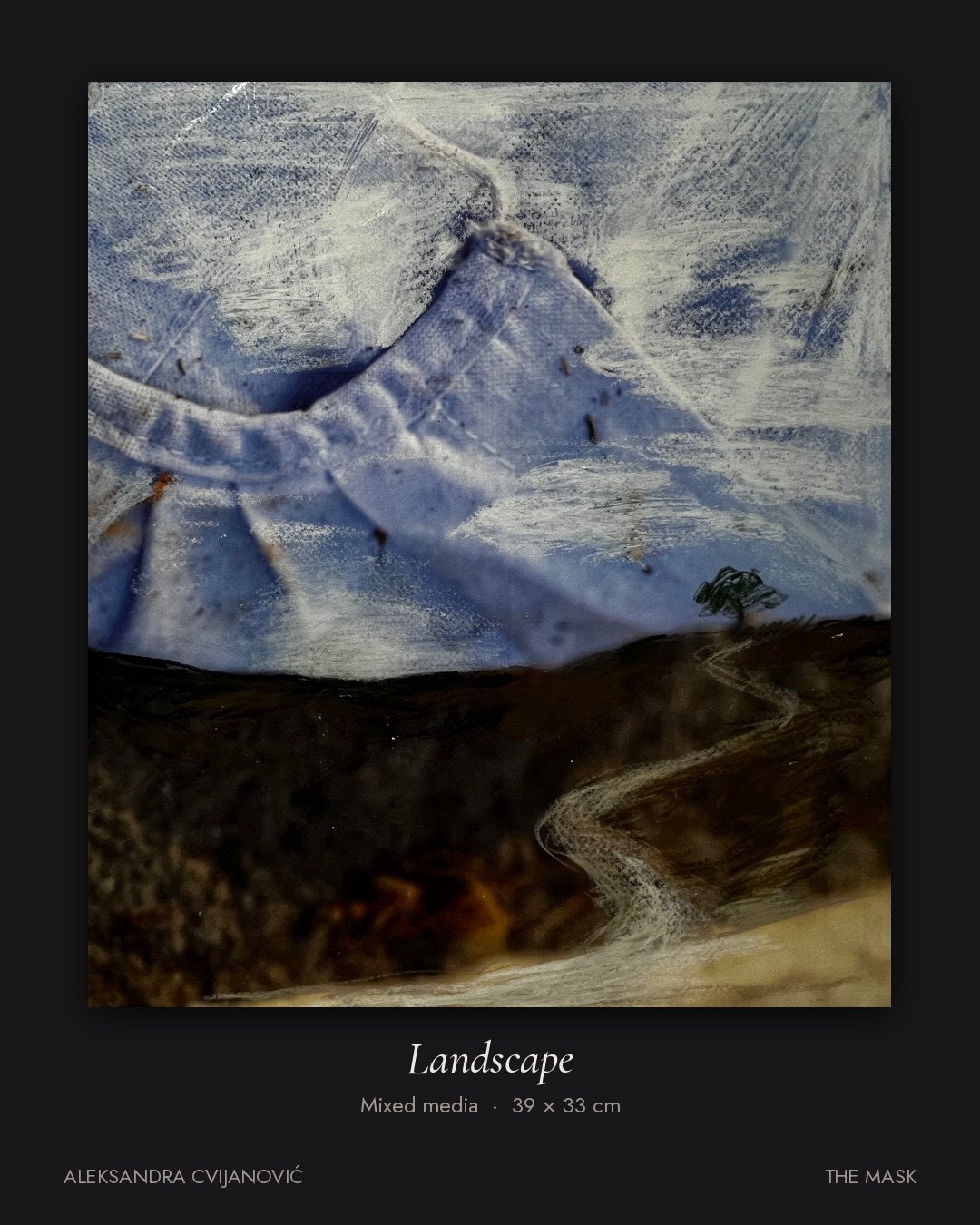
The Mask: These are not the dunes

This is not a mountain.

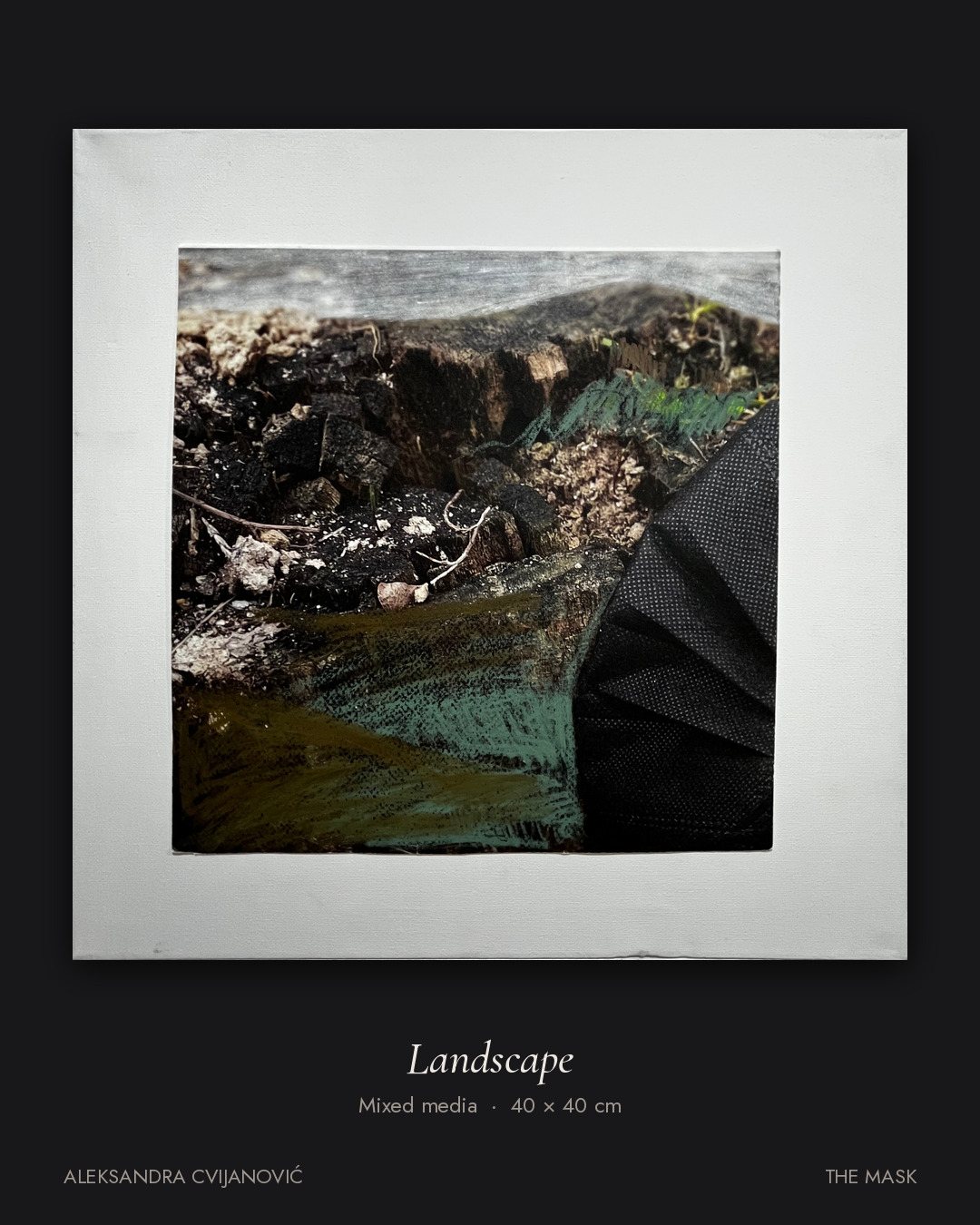
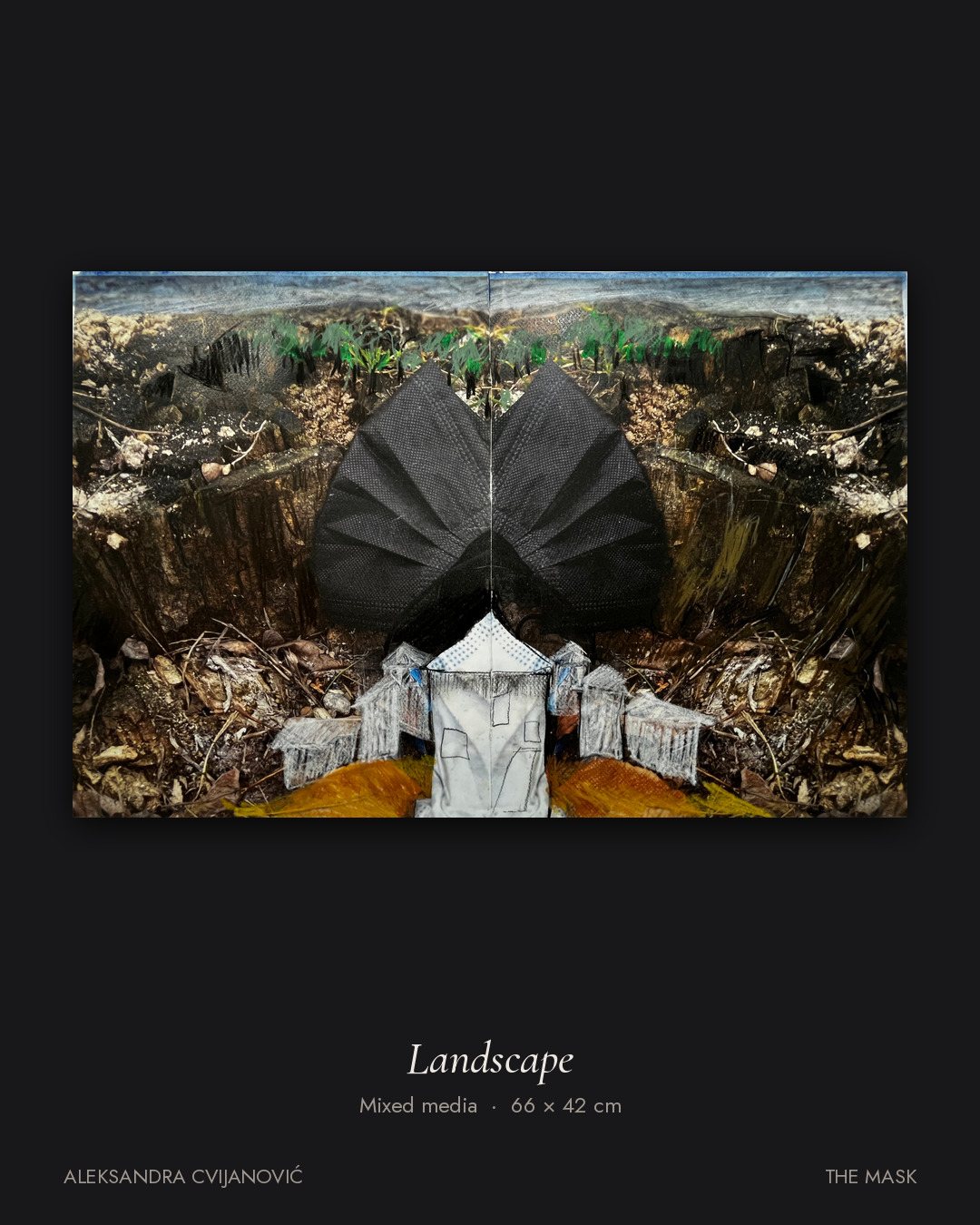
Look closer. The landscapes of The Mask are scenes of abandoned masks, enhanced with acrylic detail. A snowy peak, a road at night, a stretch of sky: each one began as something we wore to protect one another, and then threw away.

For centuries the mask connected people to something greater than themselves, from African ceremony to Greek theatre. The pandemic gave it a darker counterpart: millions of discarded masks in streets, parks, rivers and oceans. This series asks us to reconsider every object we use and throw away.

See the works in person at DIFC Art Nights, Gate Village, 12–15 November, 5–10 pm. Find the wall, and look closer.

The whole series: cvijanovicaleks.art/difc-art-nights

The Mask · Mixed media

For inquiries: cvijanovic.aleksart@gmail.com · cvijanovicaleks.art

World Art Dubai announcement

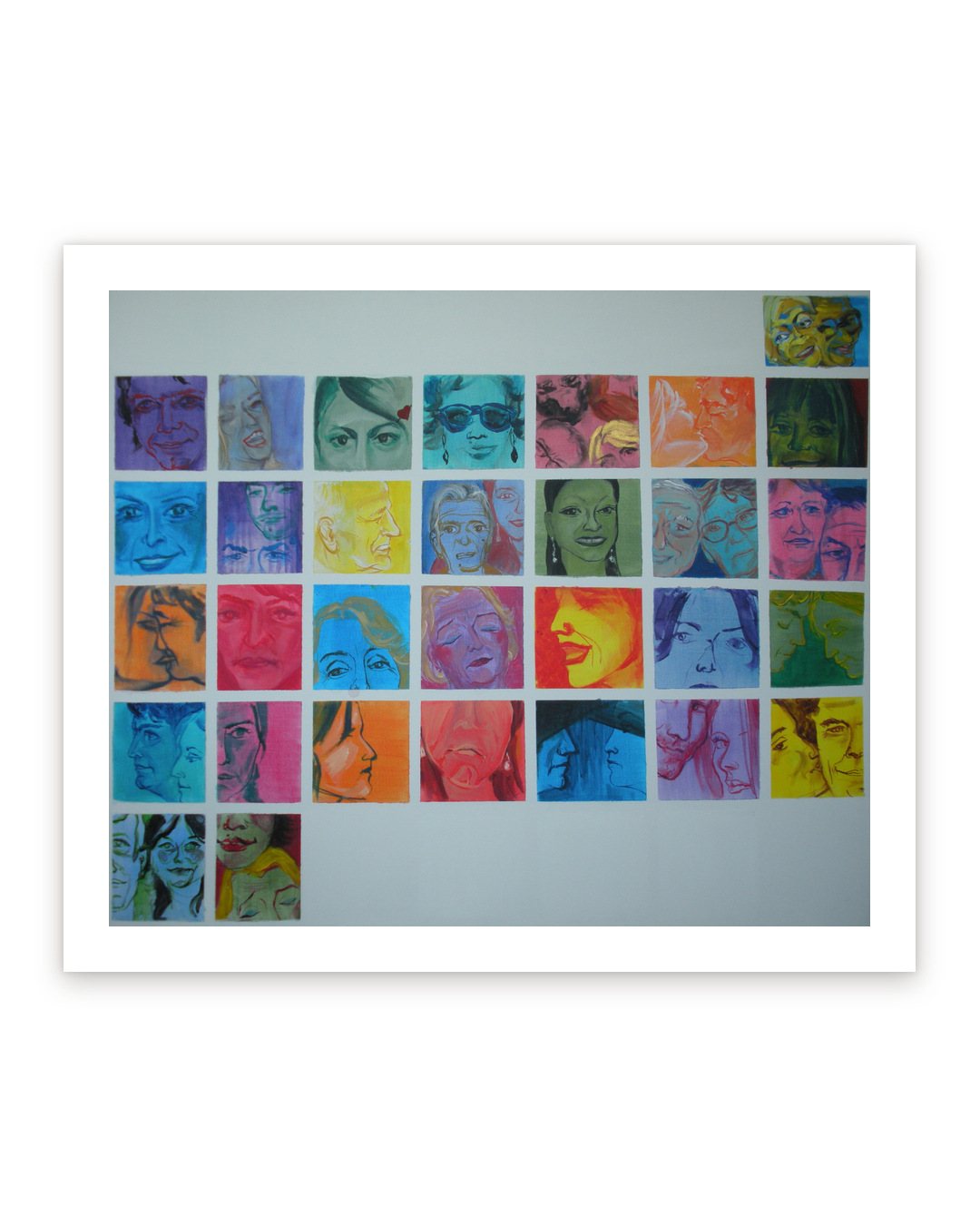
Announcement on a warm off-white background: Academic painter Aleksandra Cvijanović. The Calendar at World Art Dubai. Three months from The Calendar in white frames, March with colourful faces, July in hot reds and yellows, and September in blues and greys. Below: 19–22 November 2026, Dubai World Trade Centre, and a dark red pill reading Stand OB04, with cvijanovicaleks.art and @cvijanovic.aleksart at the bottom.

The Calendar is coming to World Art Dubai.

From 19 to 22 November, The Calendar by academic painter Aleksandra Cvijanović will be shown at World Art Dubai, at Dubai World Trade Centre, stand OB04.

The Calendar is one year kept as a diary in paint: twelve large canvases, each built day by day from small paintings, a personal record of hopes, disruptions and small joys. One painted day is singled out from every month and stands on its own.

The canvases measure 120 × 100 cm each, acrylic on canvas. They are best seen in person: come and find them at stand OB04.

World Art Dubai · 19–22 November 2026 · Dubai World Trade Centre · Stand OB04

For inquiries: cvijanovic.aleksart@gmail.com · cvijanovicaleks.art

World Art Dubai reel: What is time?

What is time?

Is it absolute, or does every day keep its own time? The Calendar is Aleksandra Cvijanović's personal diary of one year: 365 days, painted one by one, gathered into twelve large canvases.

Seven of the months, each 120 × 100 cm in acrylic on canvas, will hang together at World Art Dubai. They were never meant for a screen. Come and see them in person.

World Art Dubai · 19–22 November 2026 · Dubai World Trade Centre, Za'abeel Halls 2–3 · Stand OB04

For inquiries: cvijanovic.aleksart@gmail.com · cvijanovicaleks.art

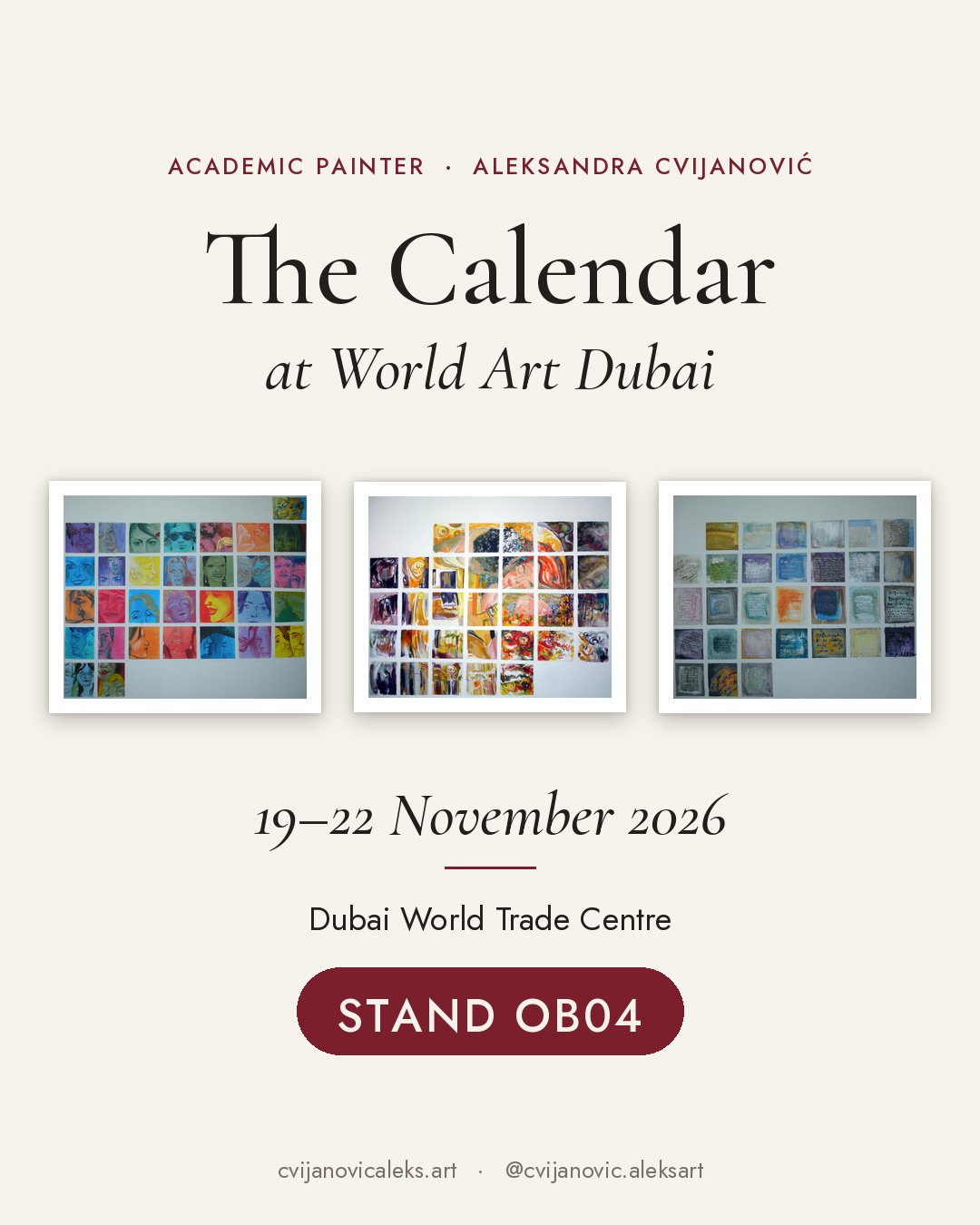
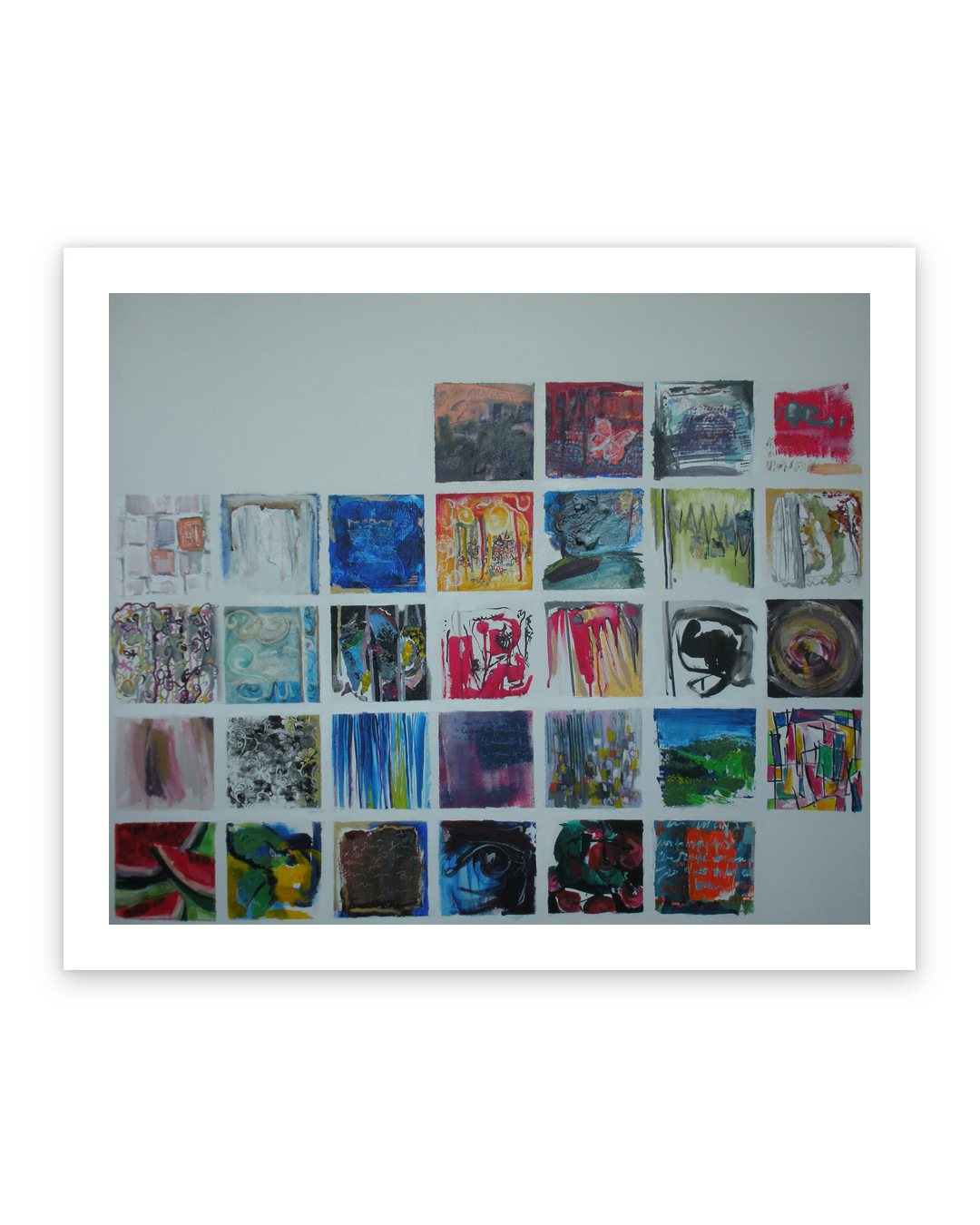
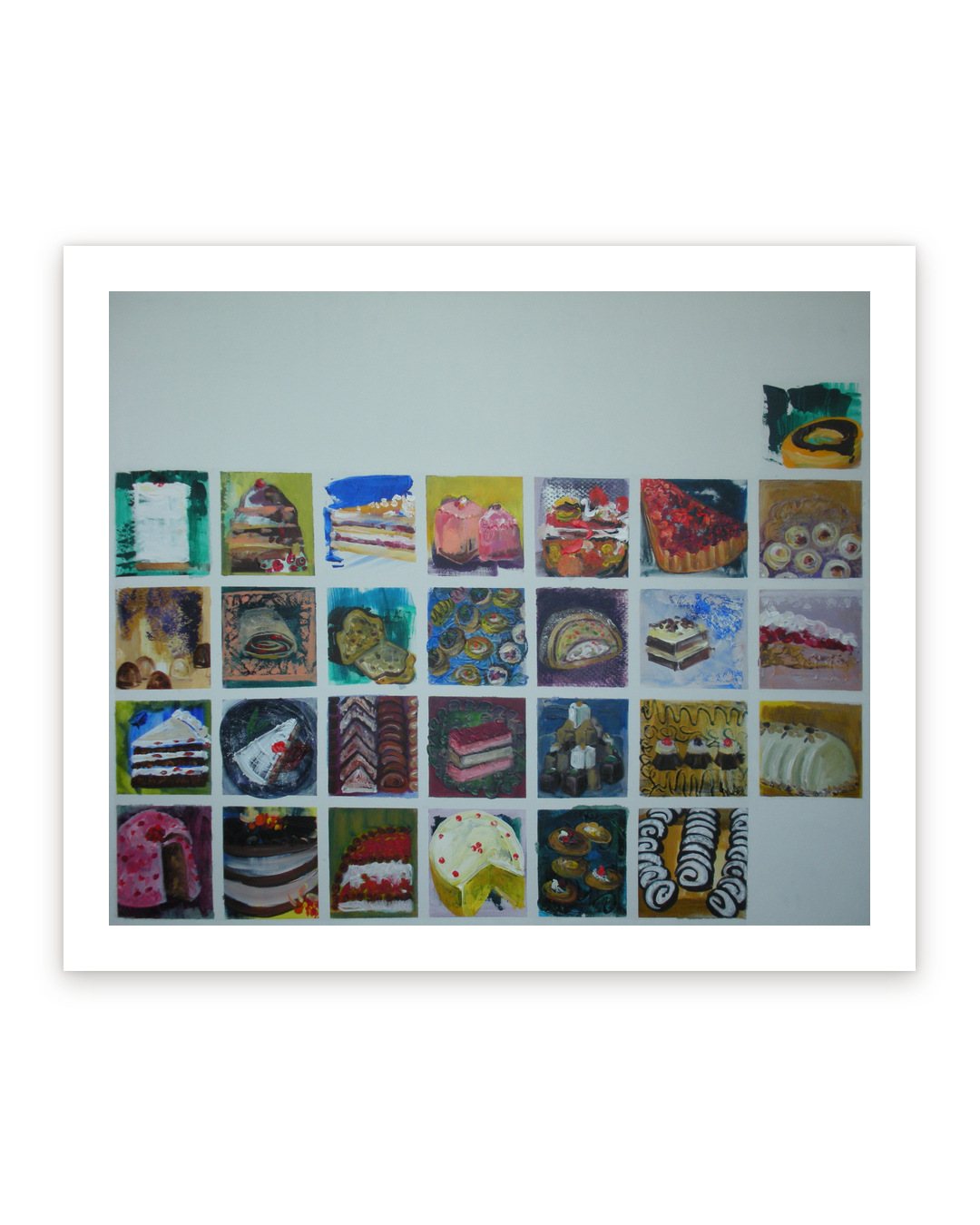
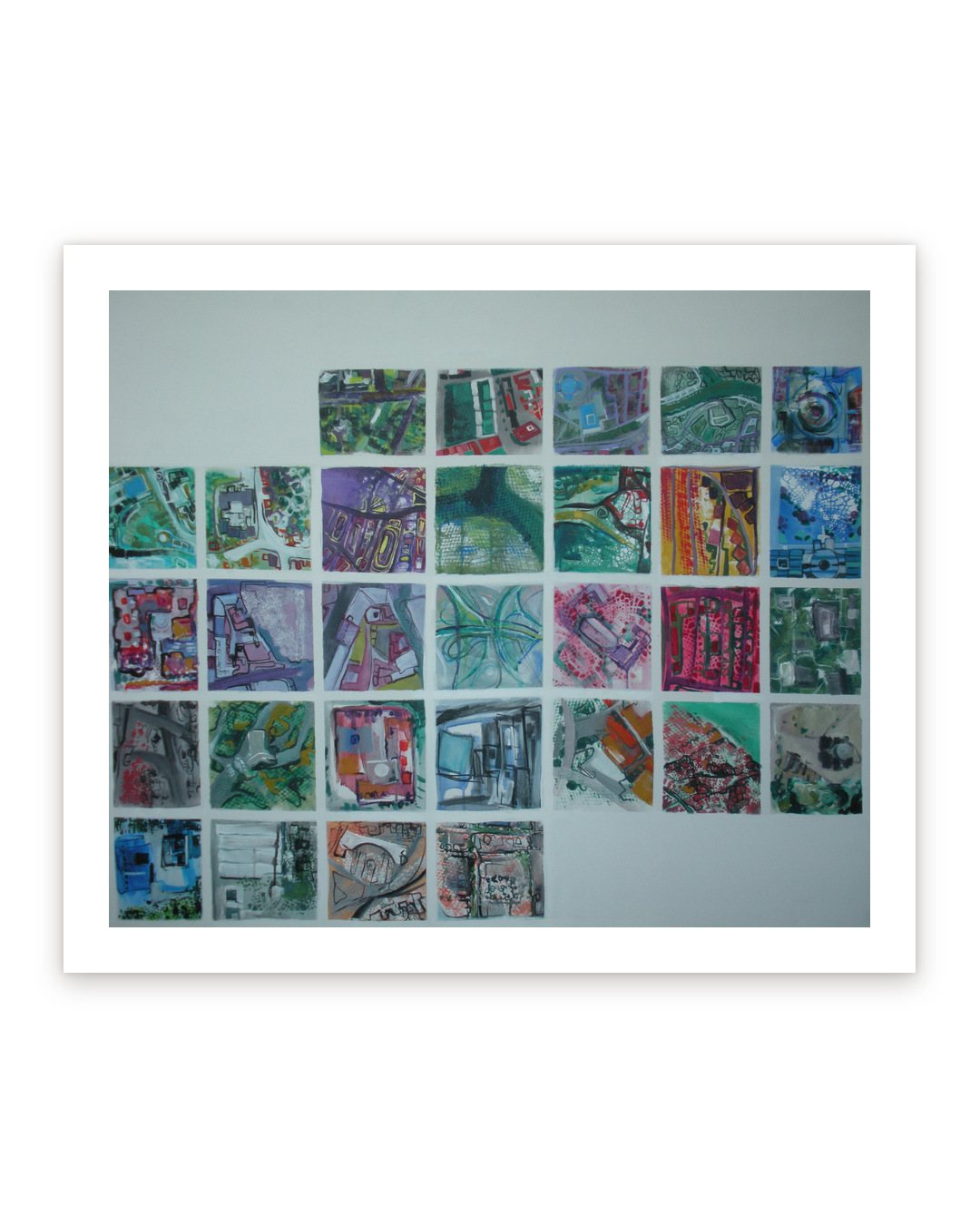
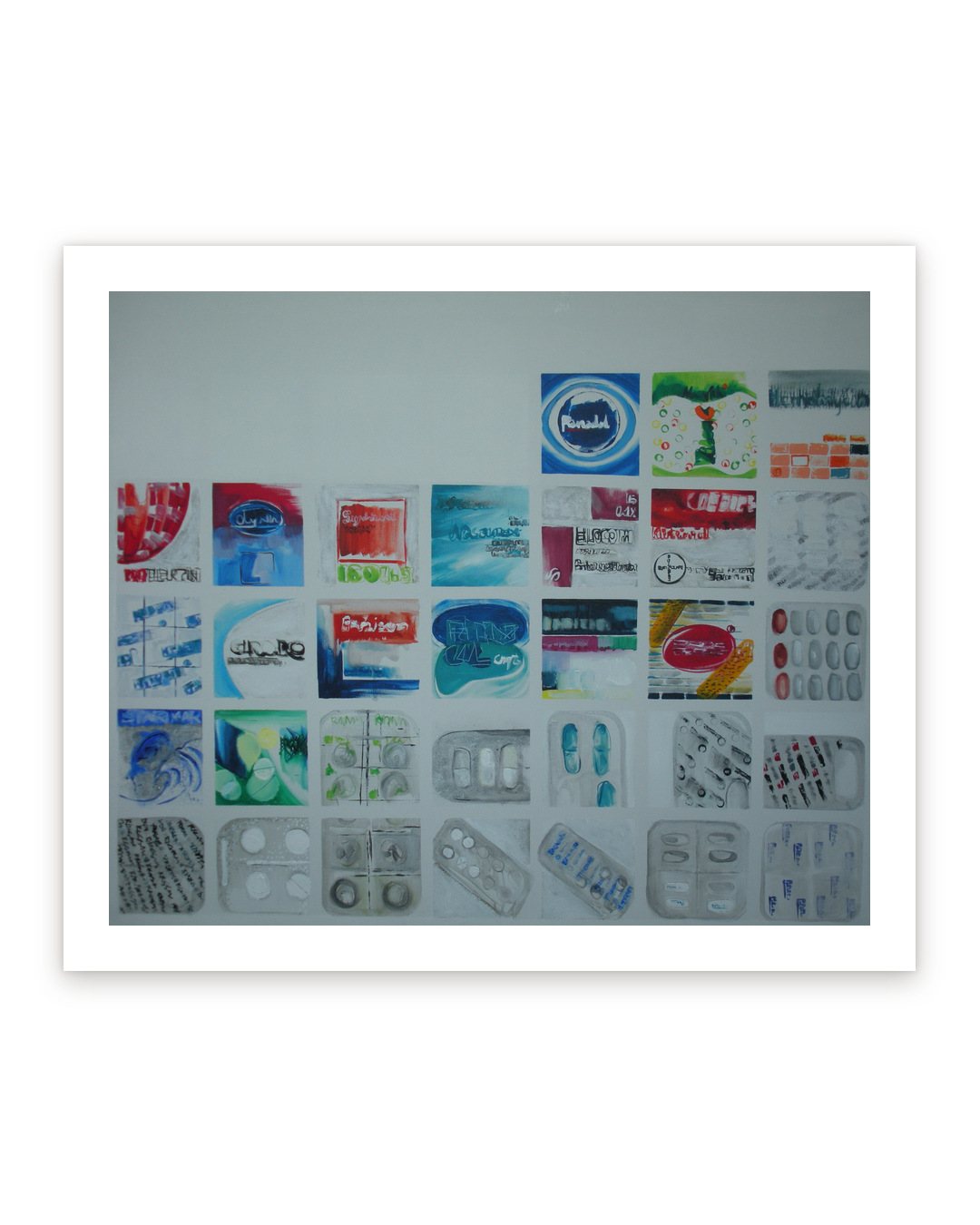
The Calendar: twelve months, framed

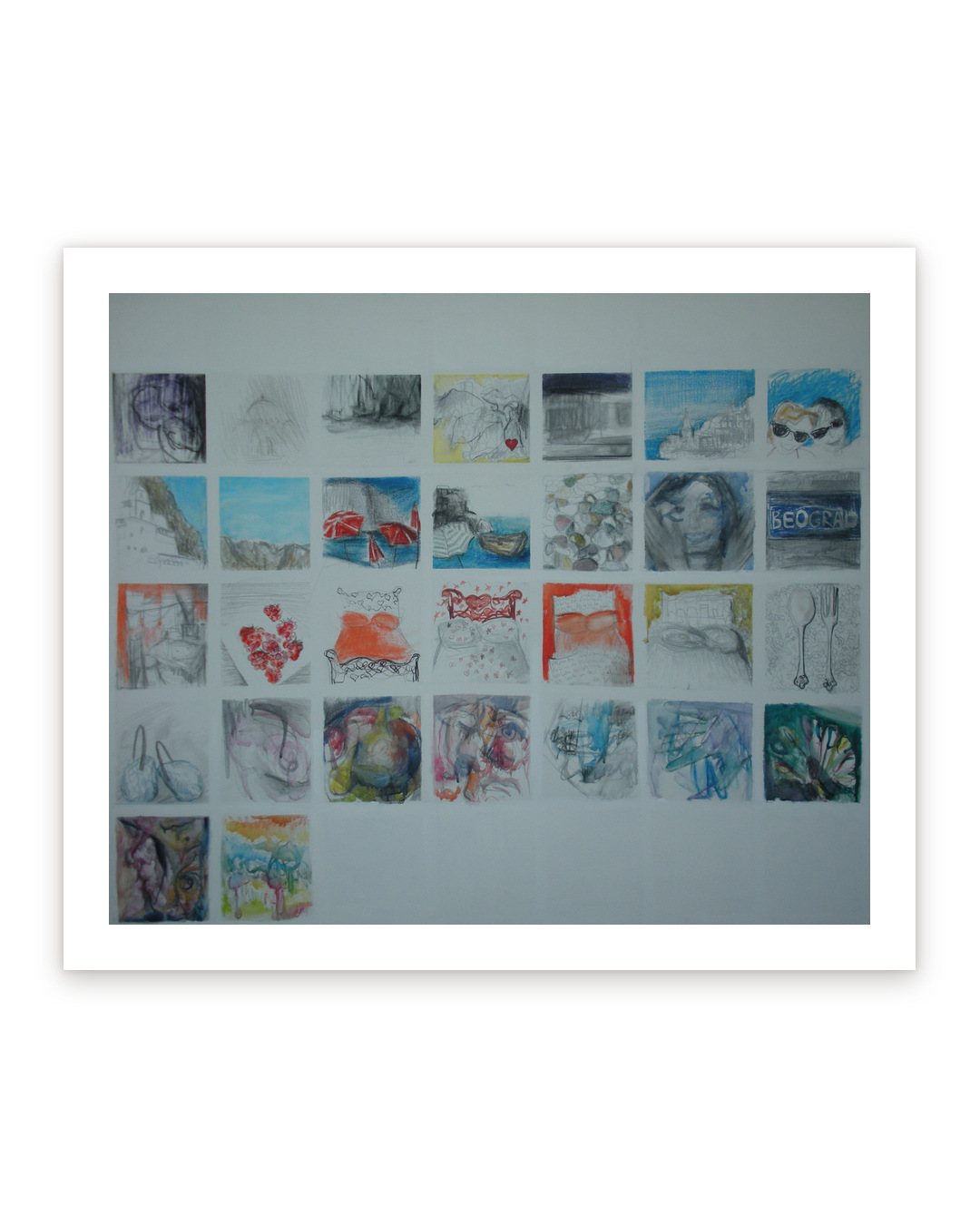
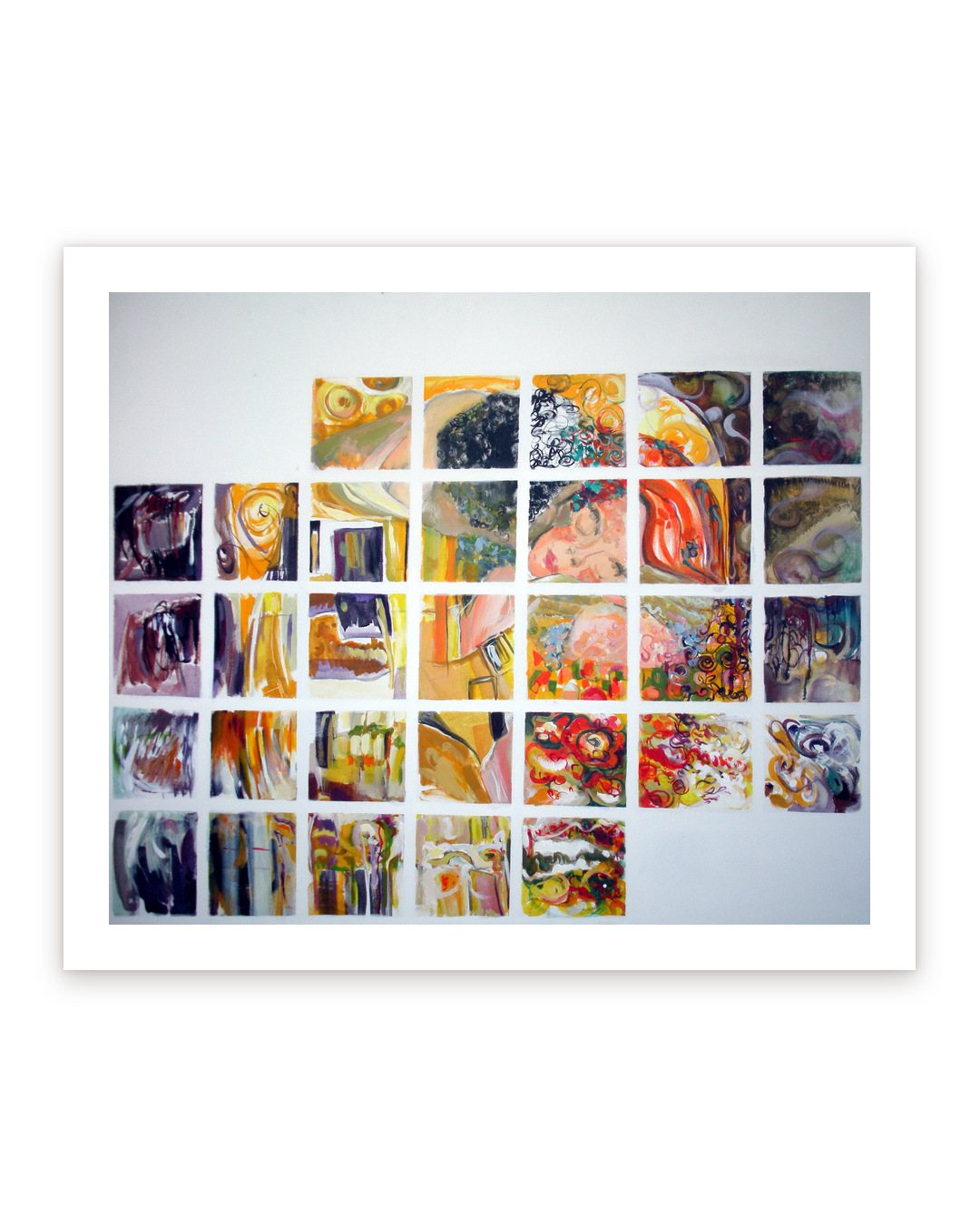
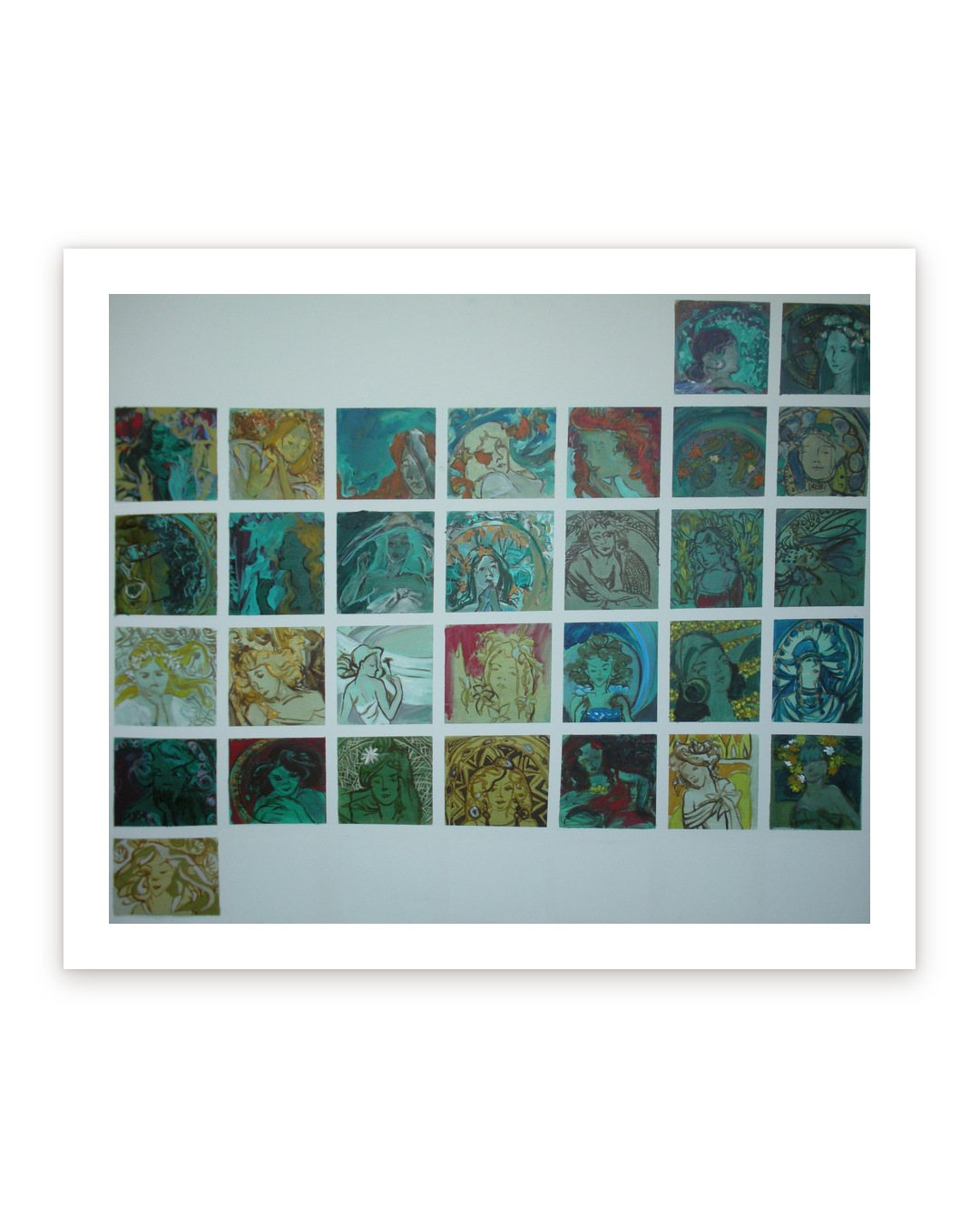
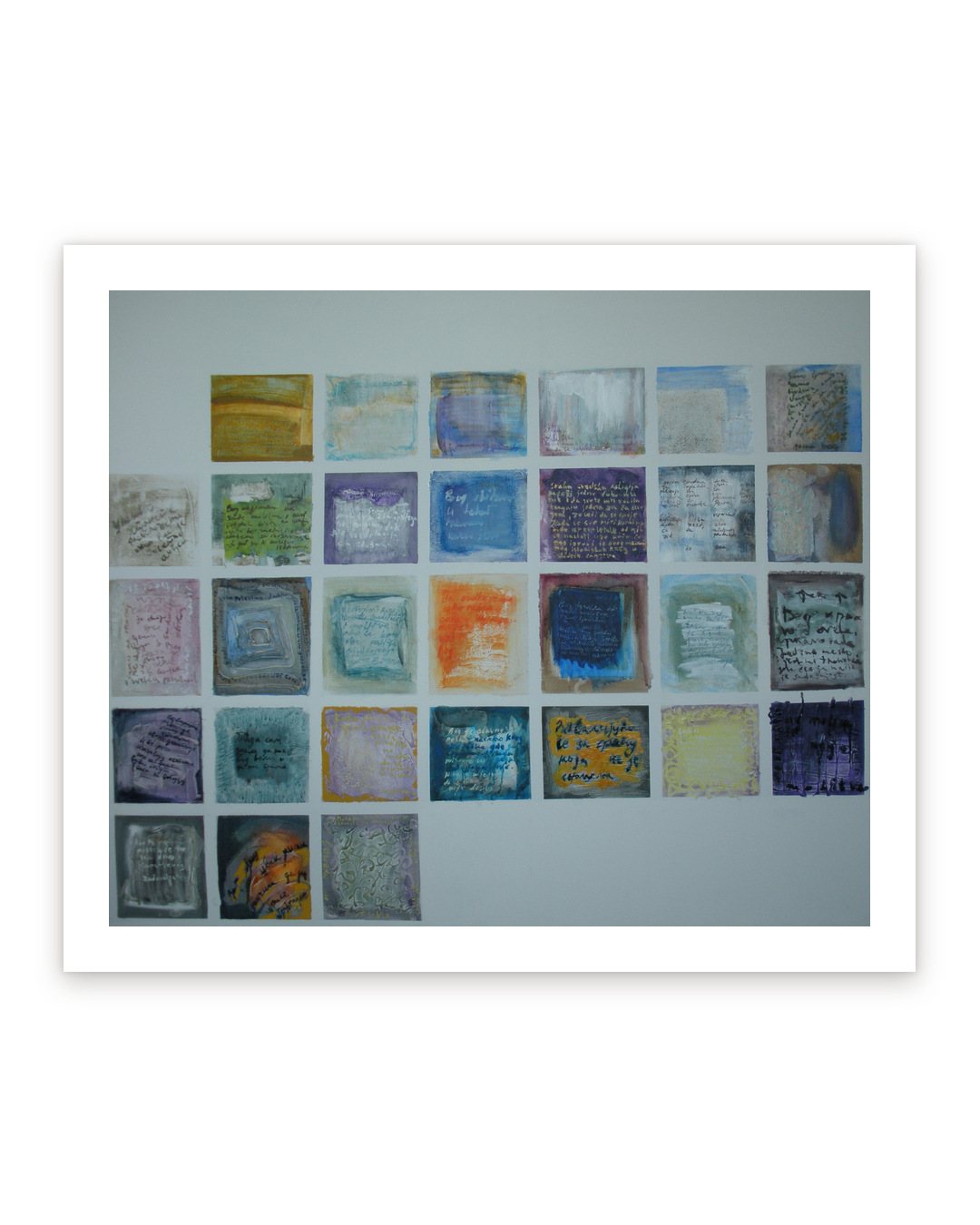
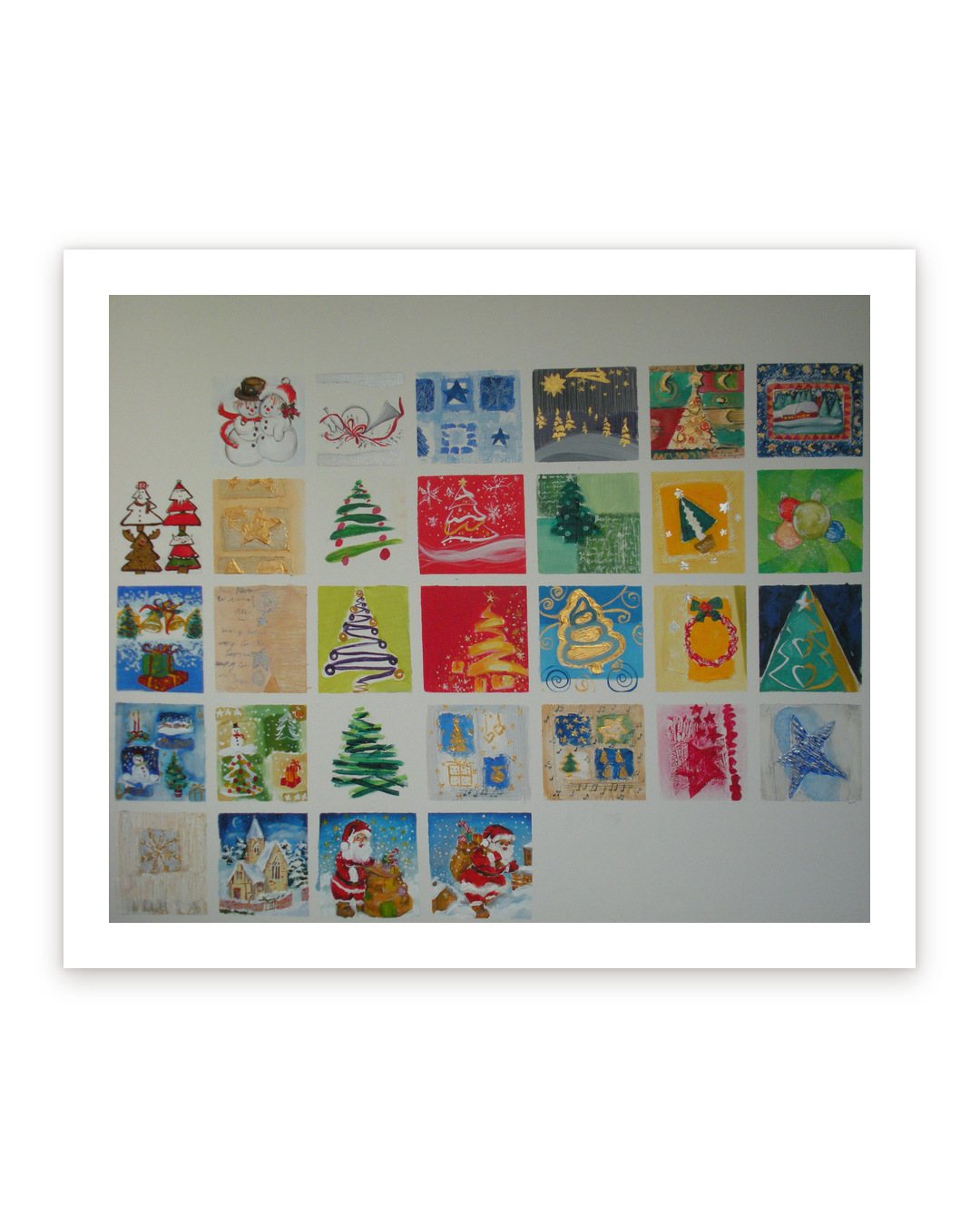
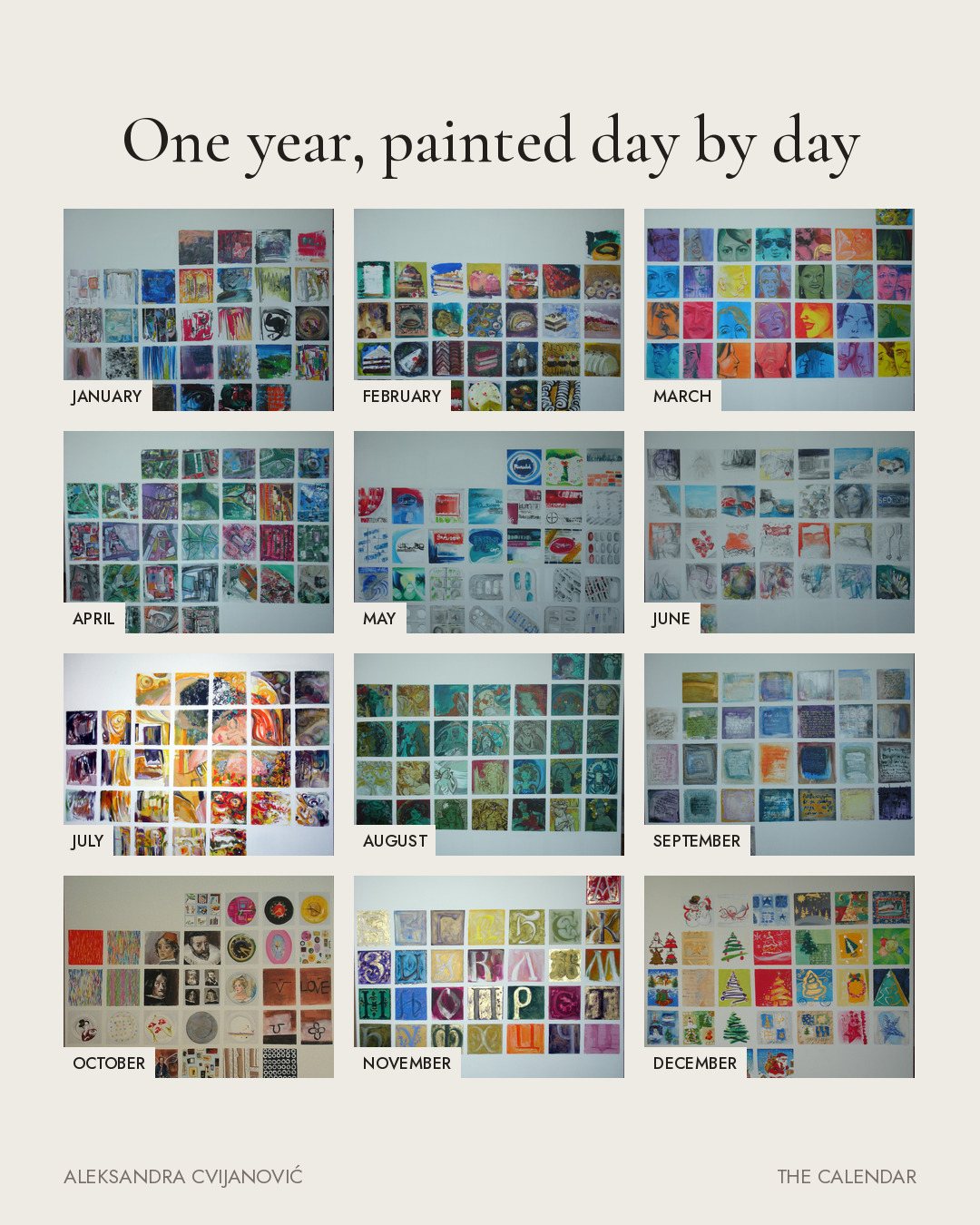
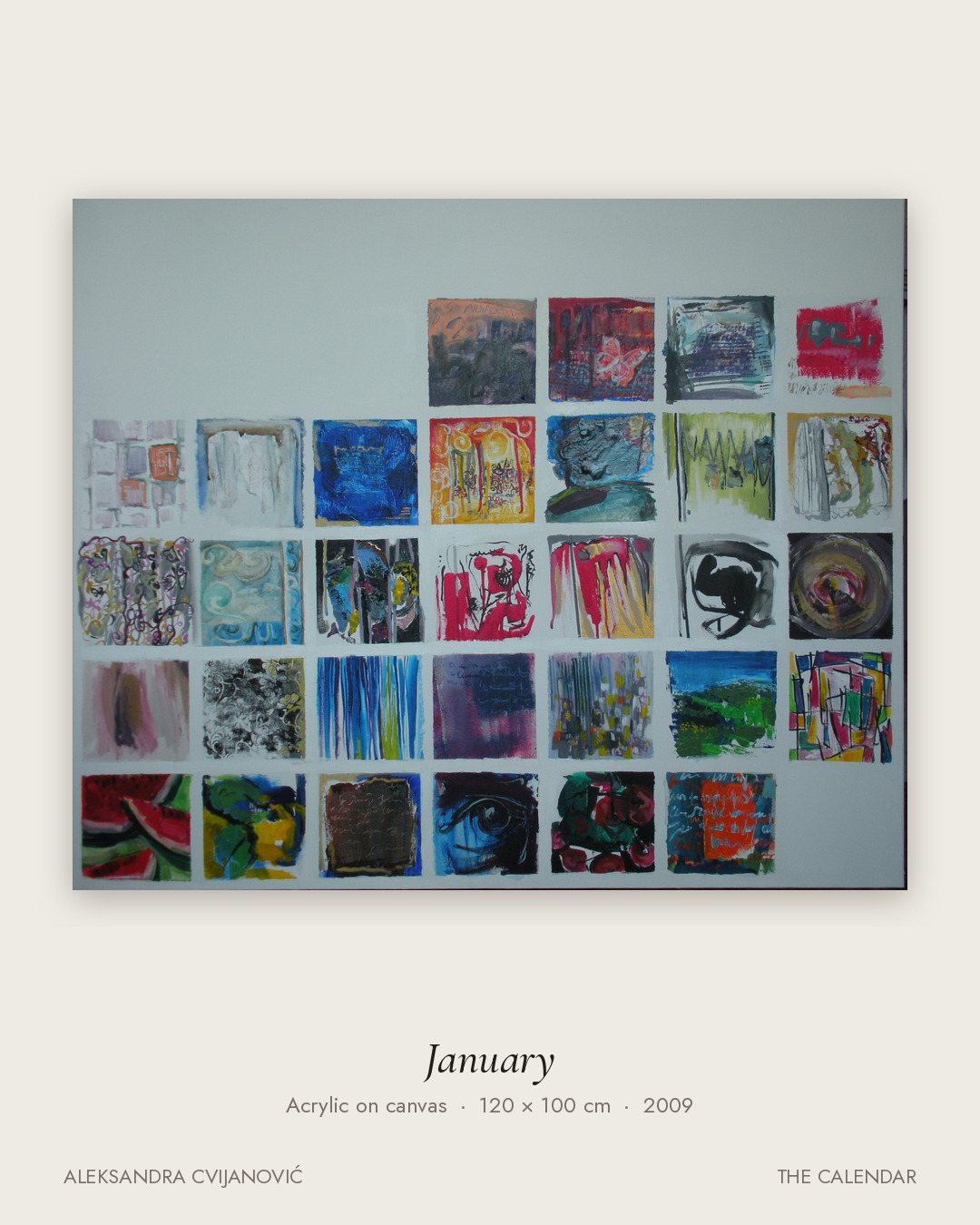
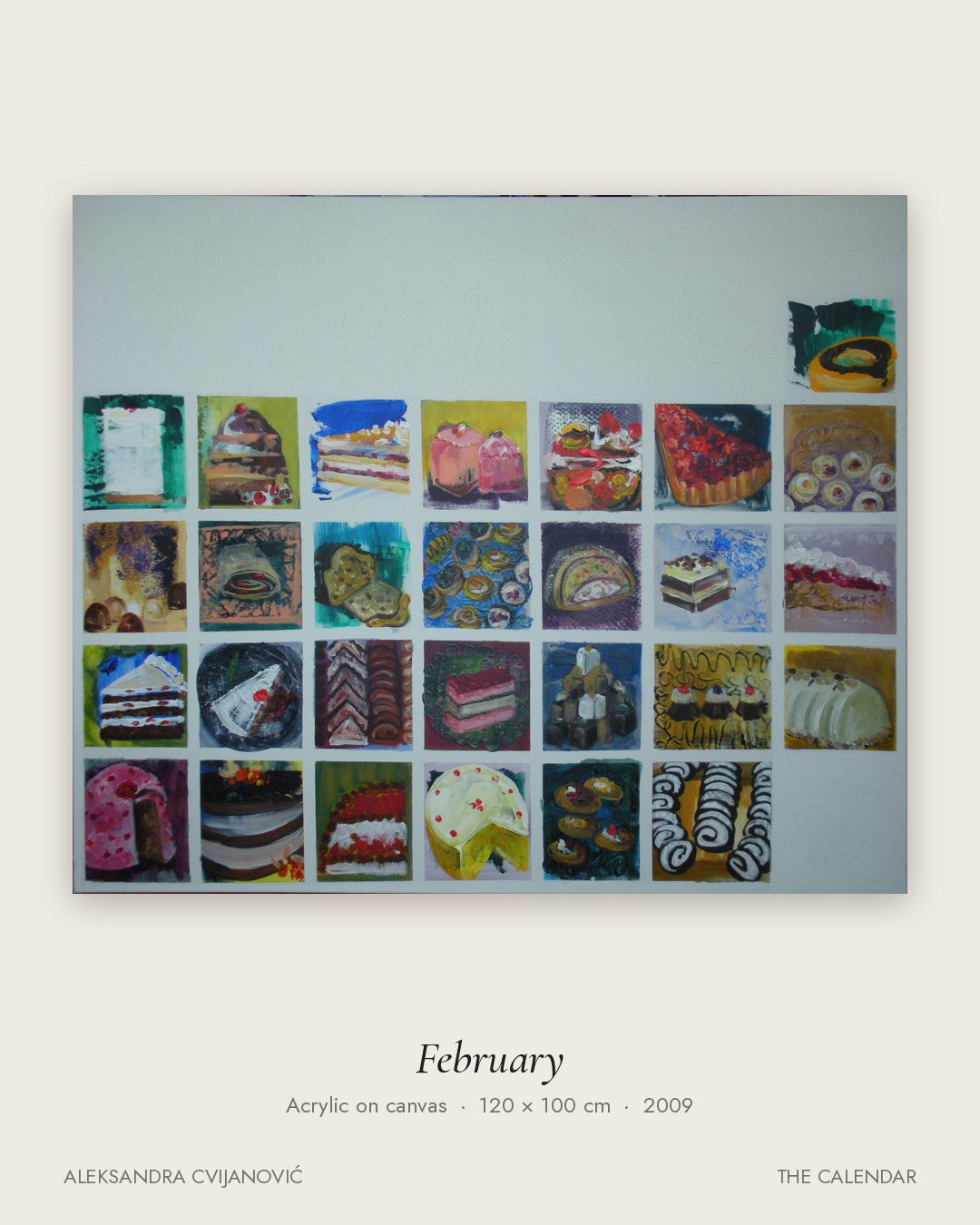
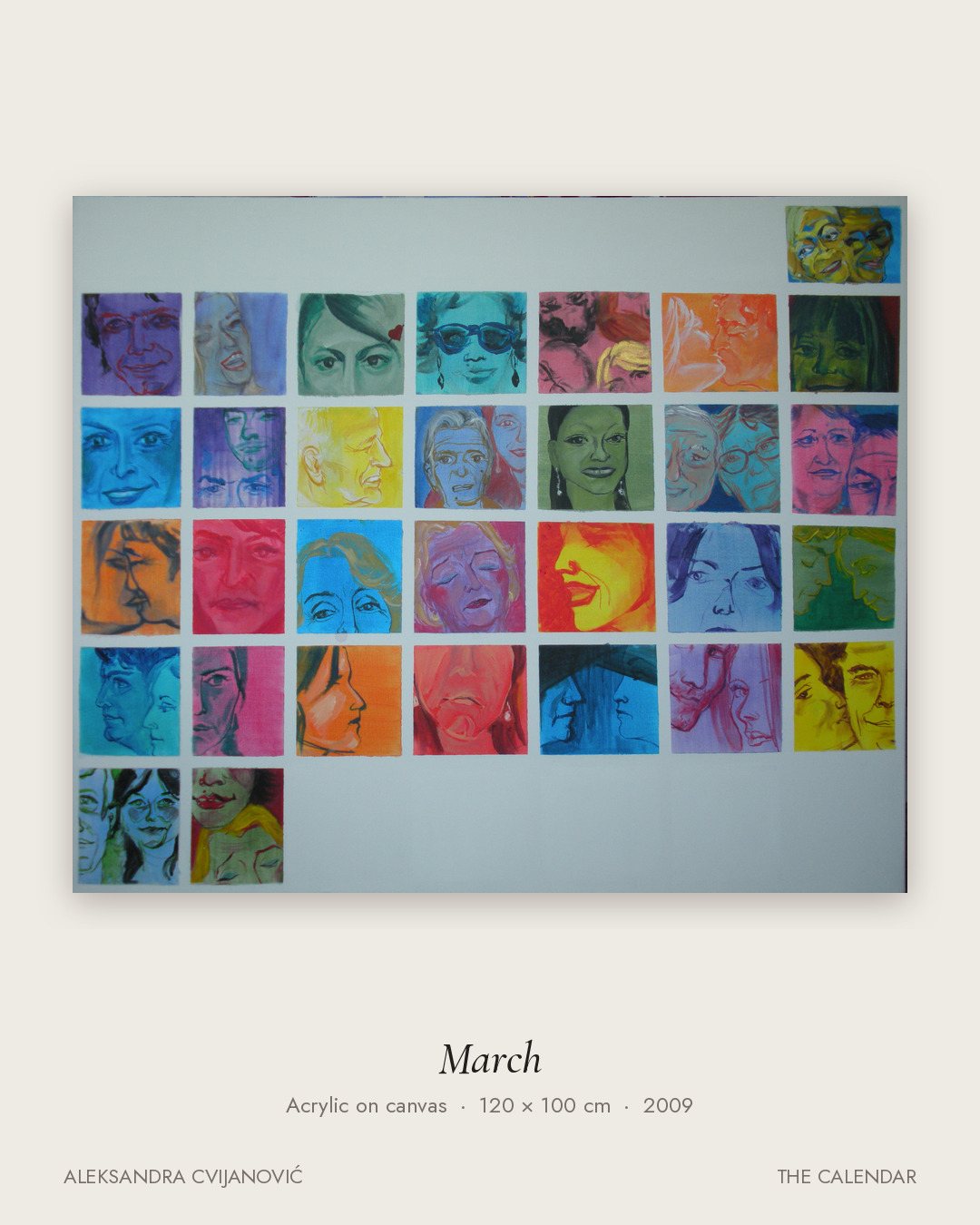
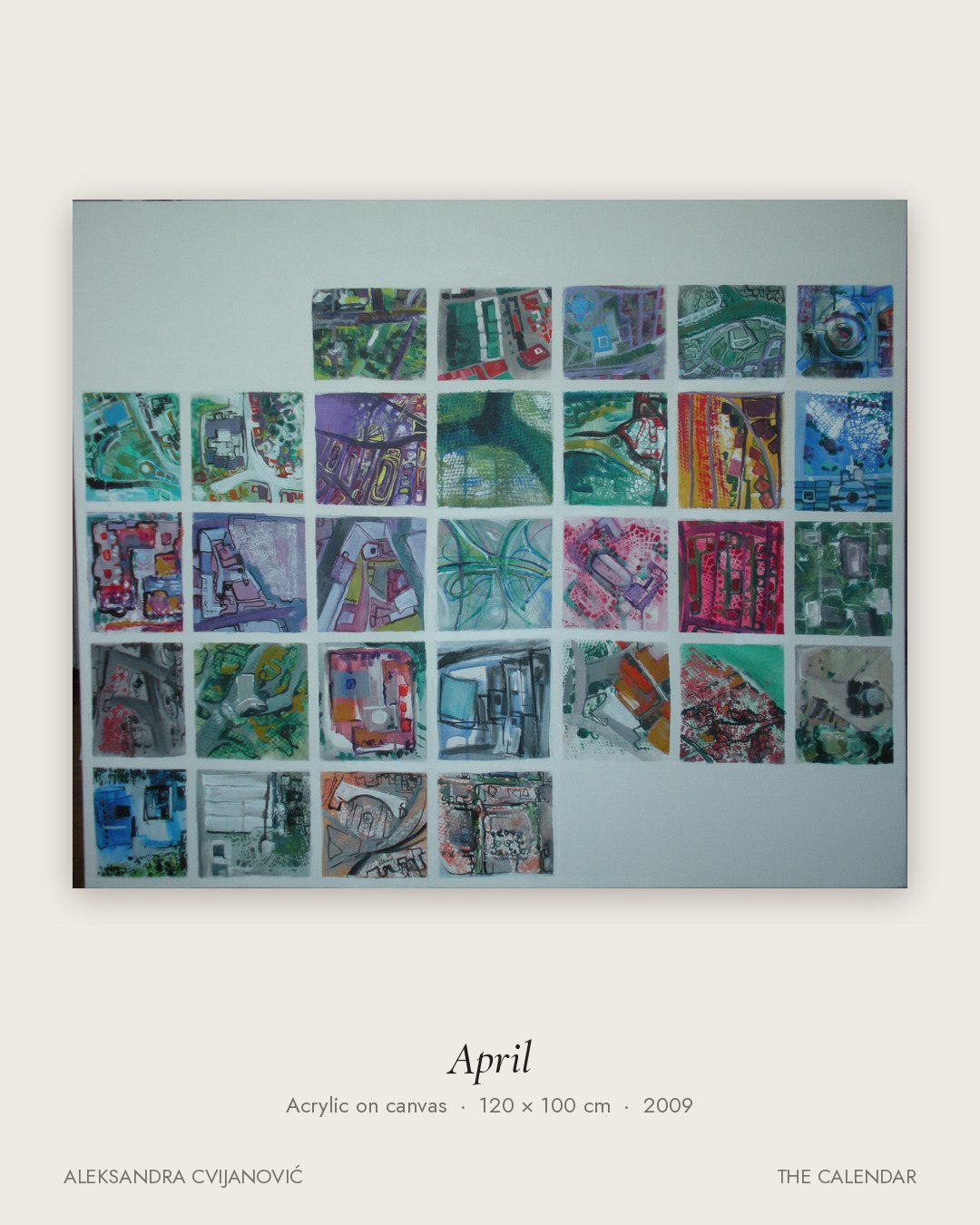
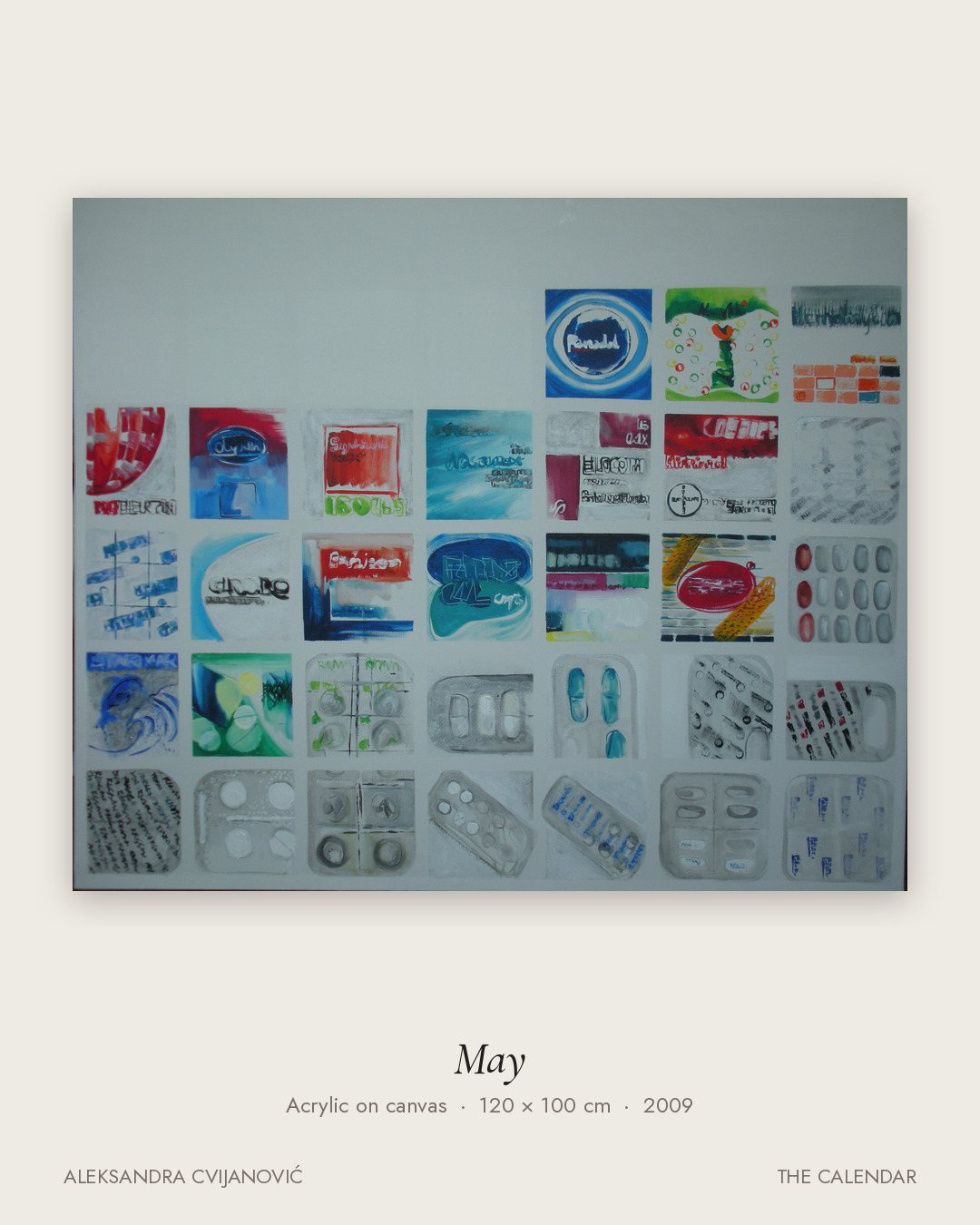
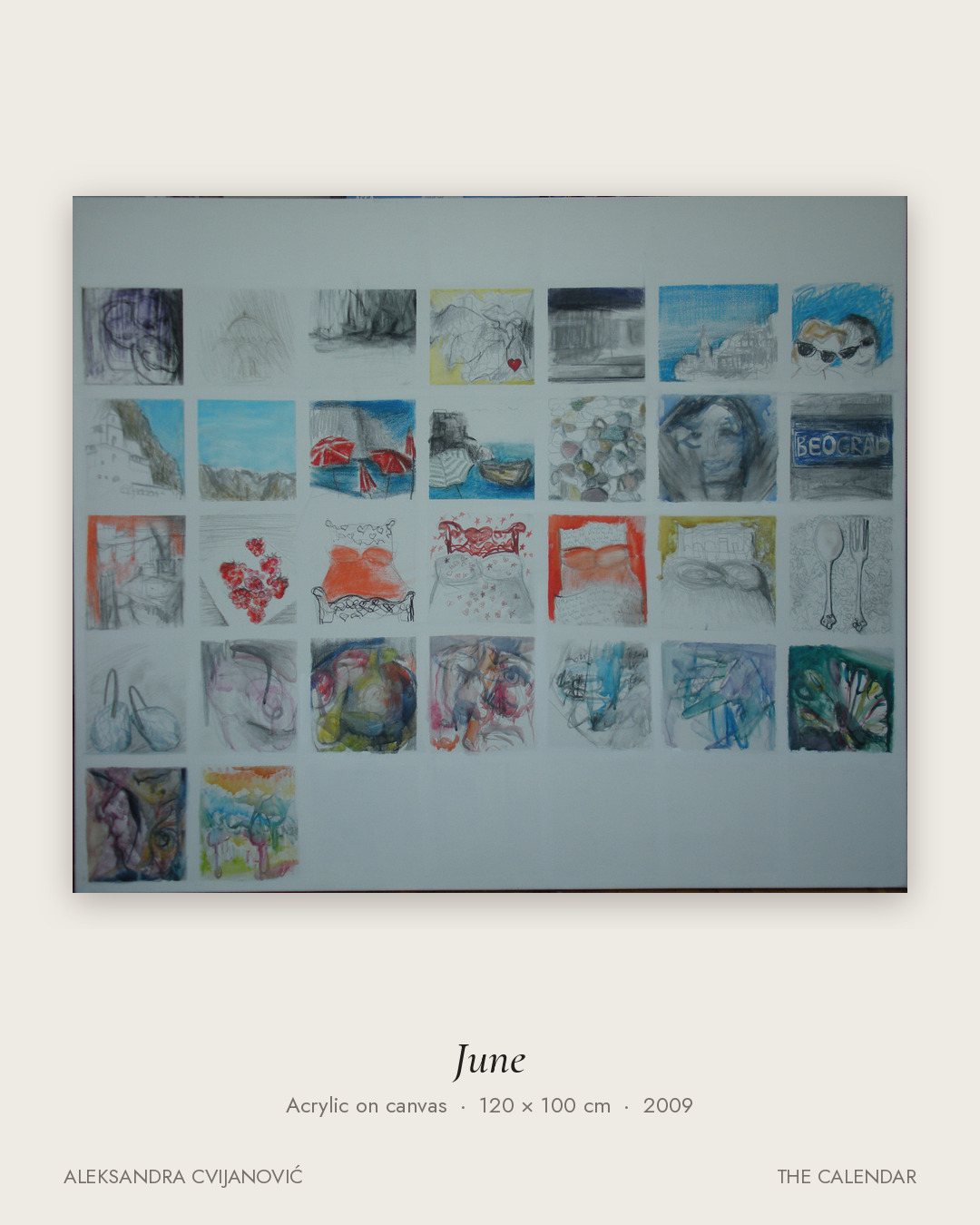
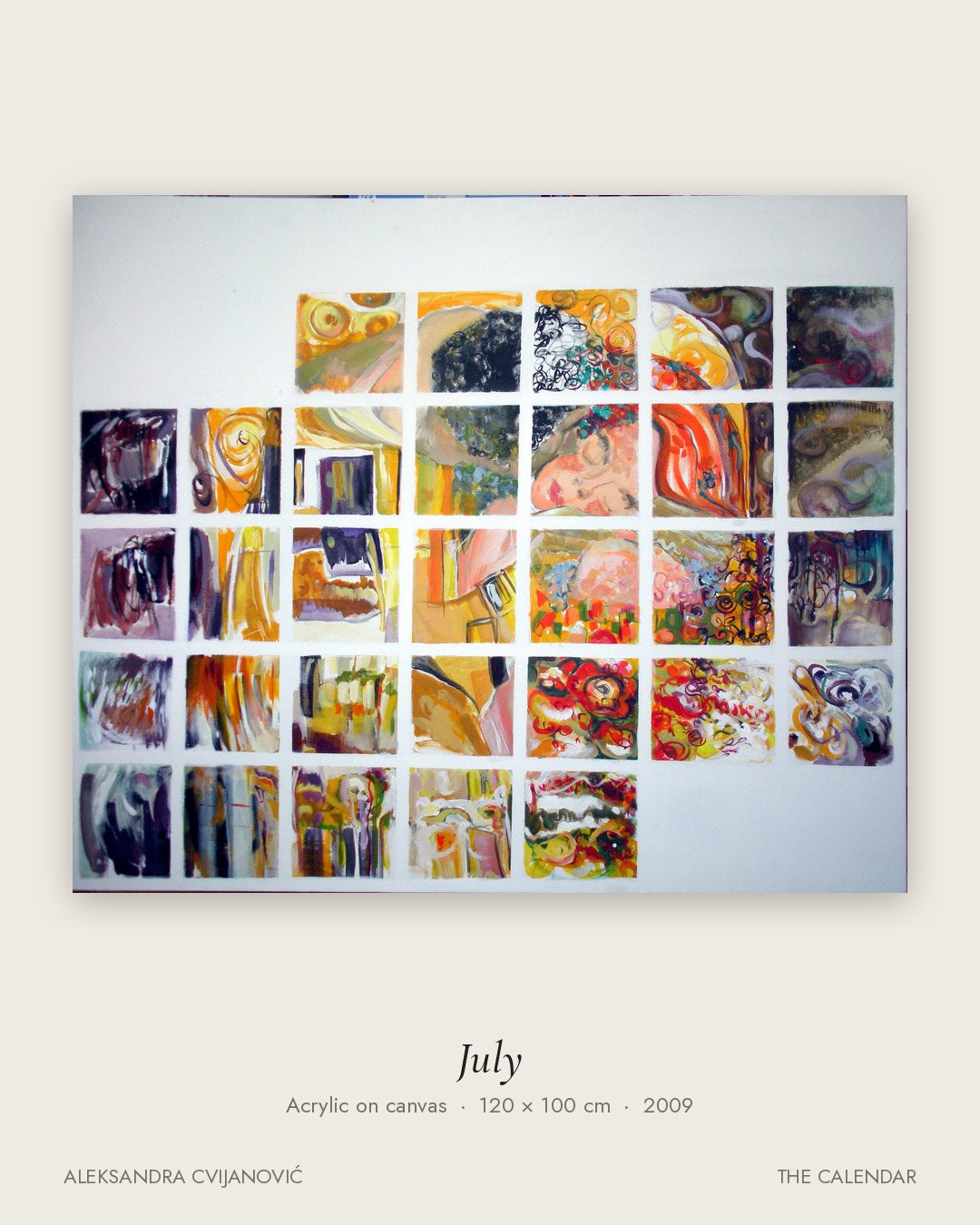
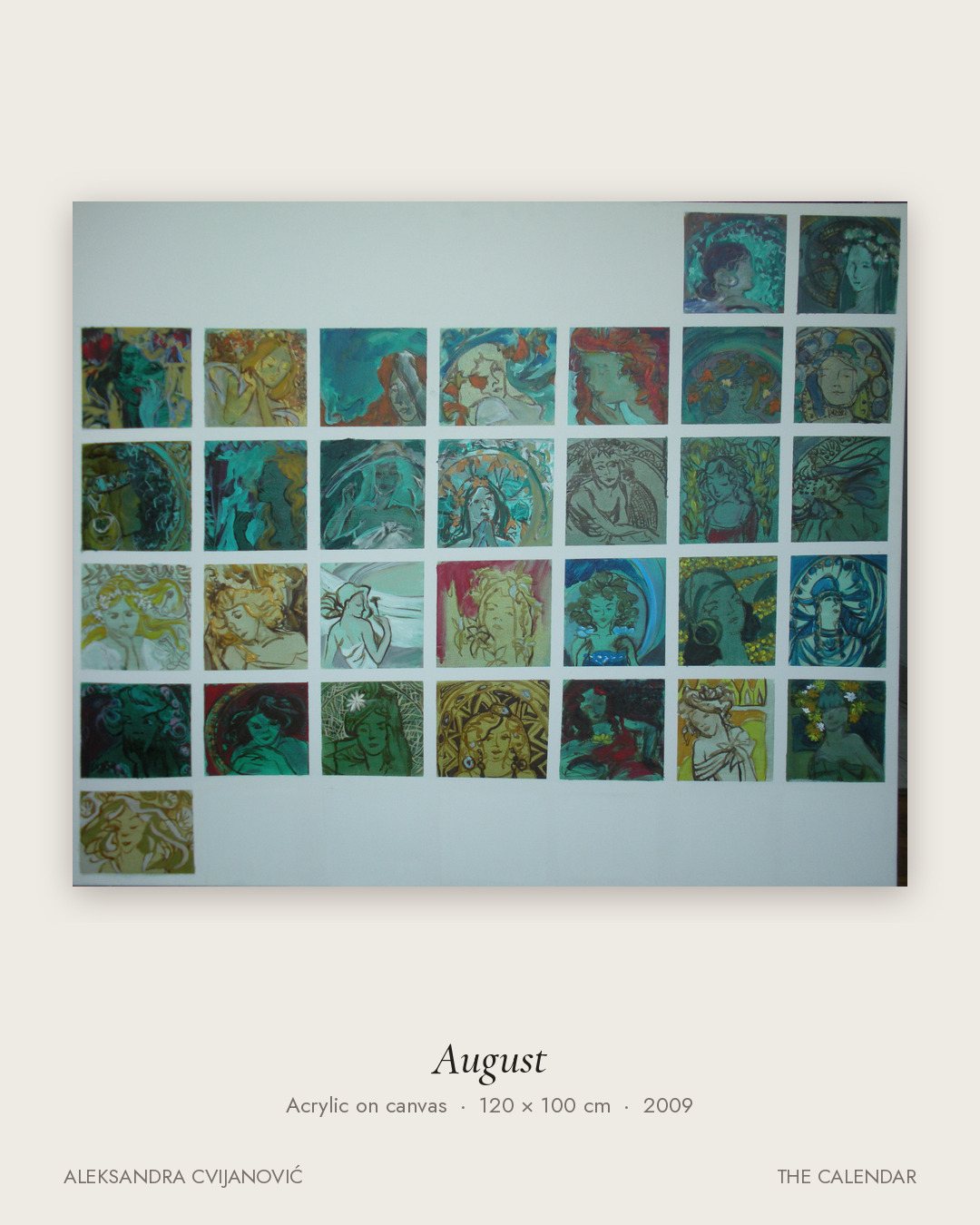
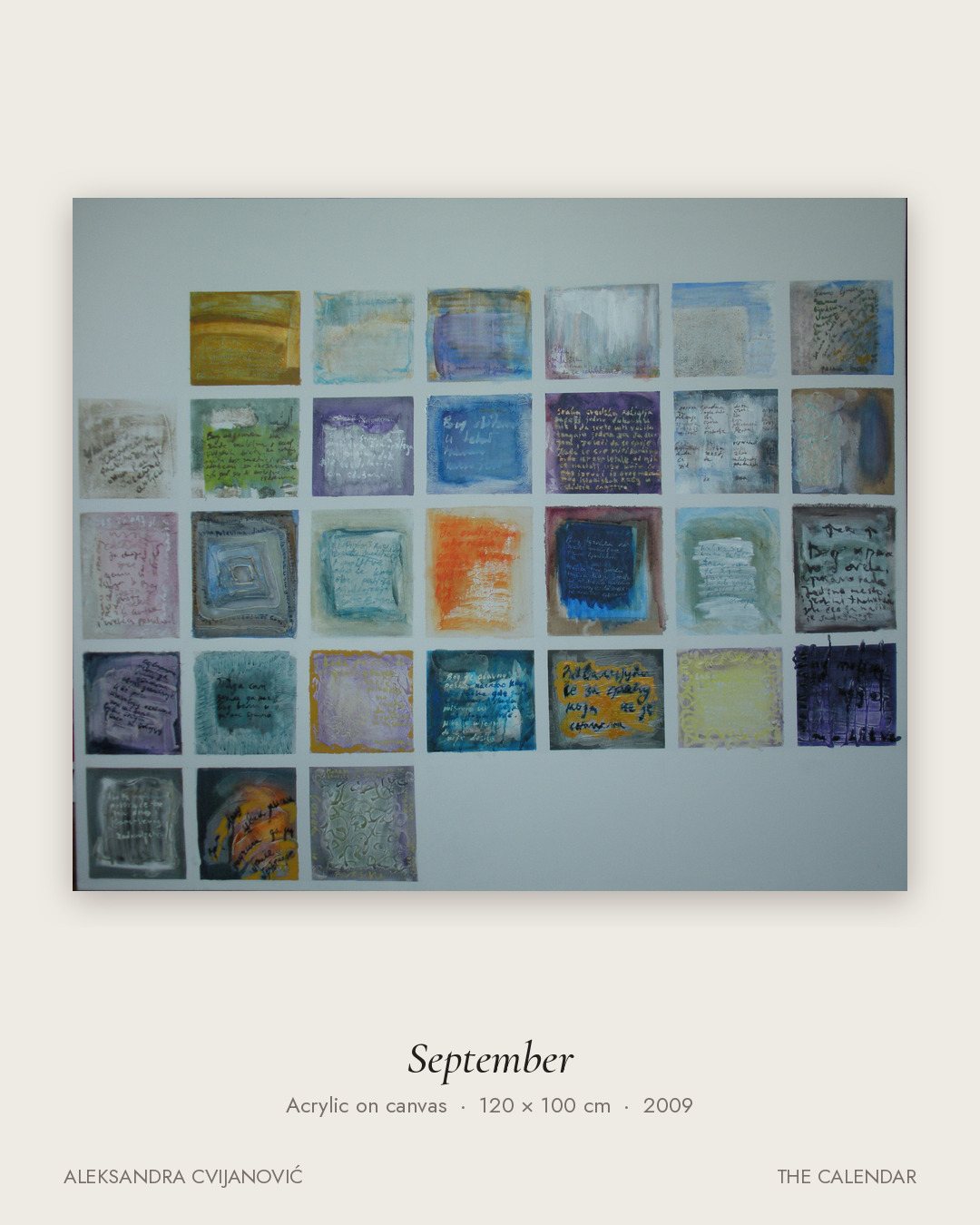
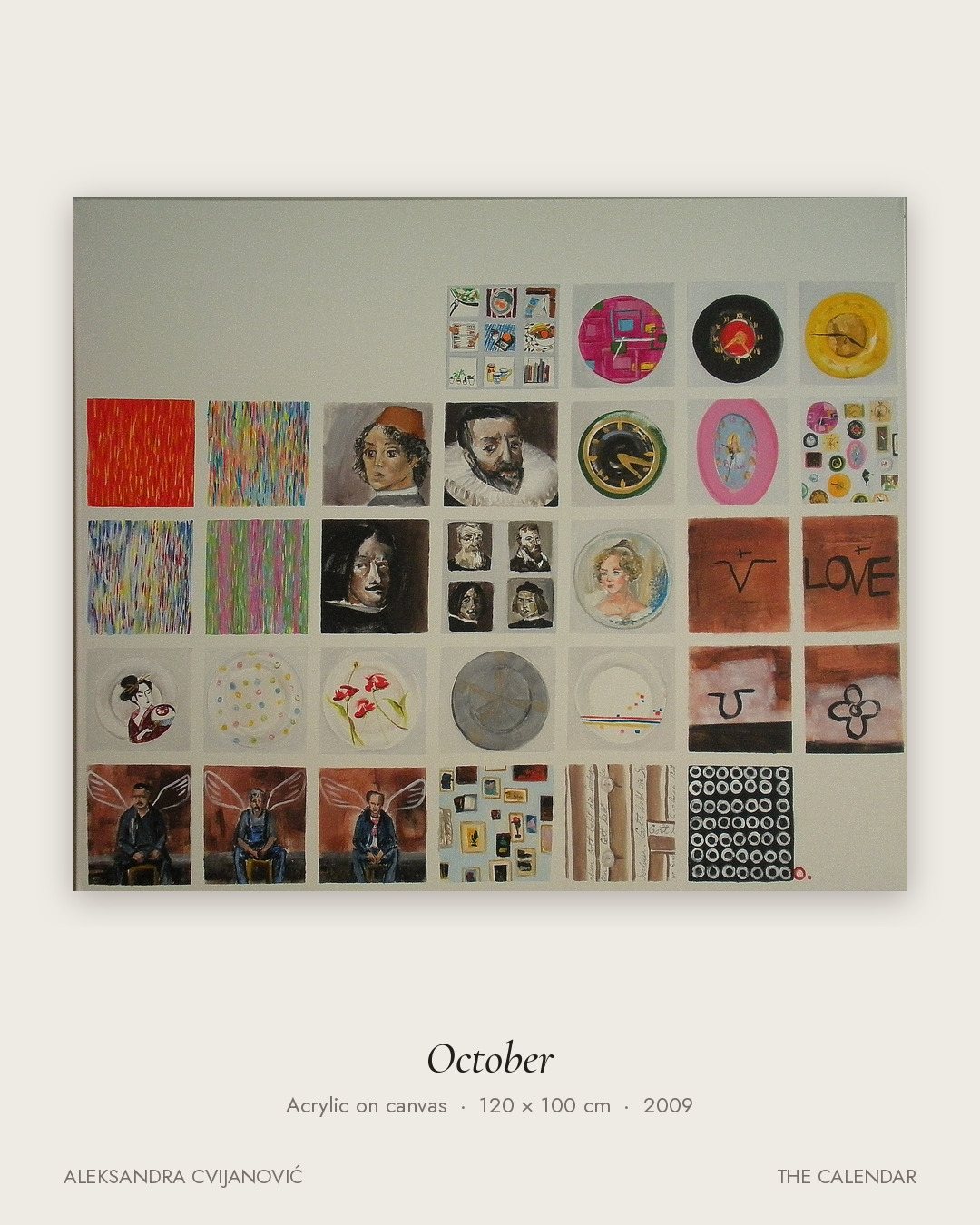
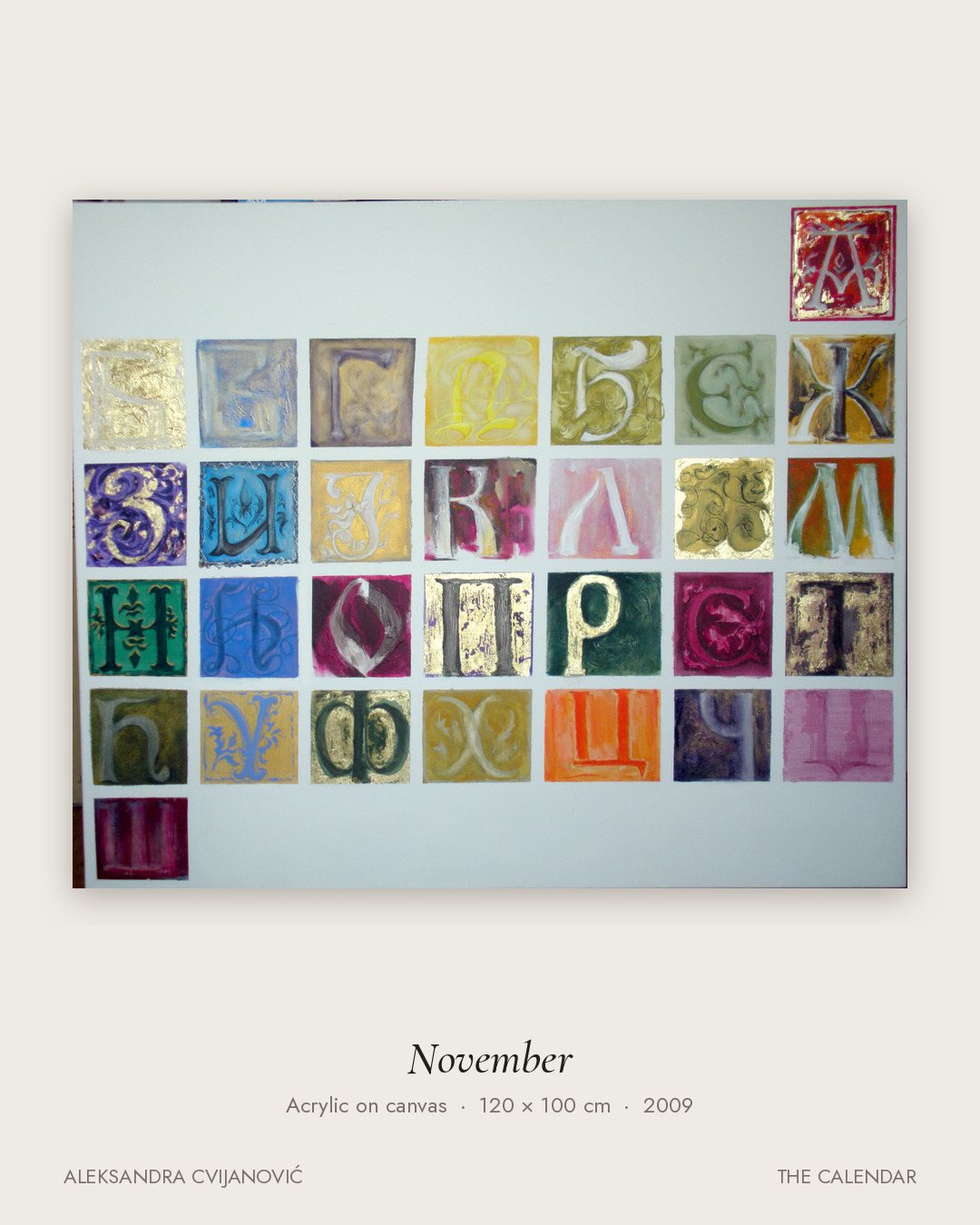
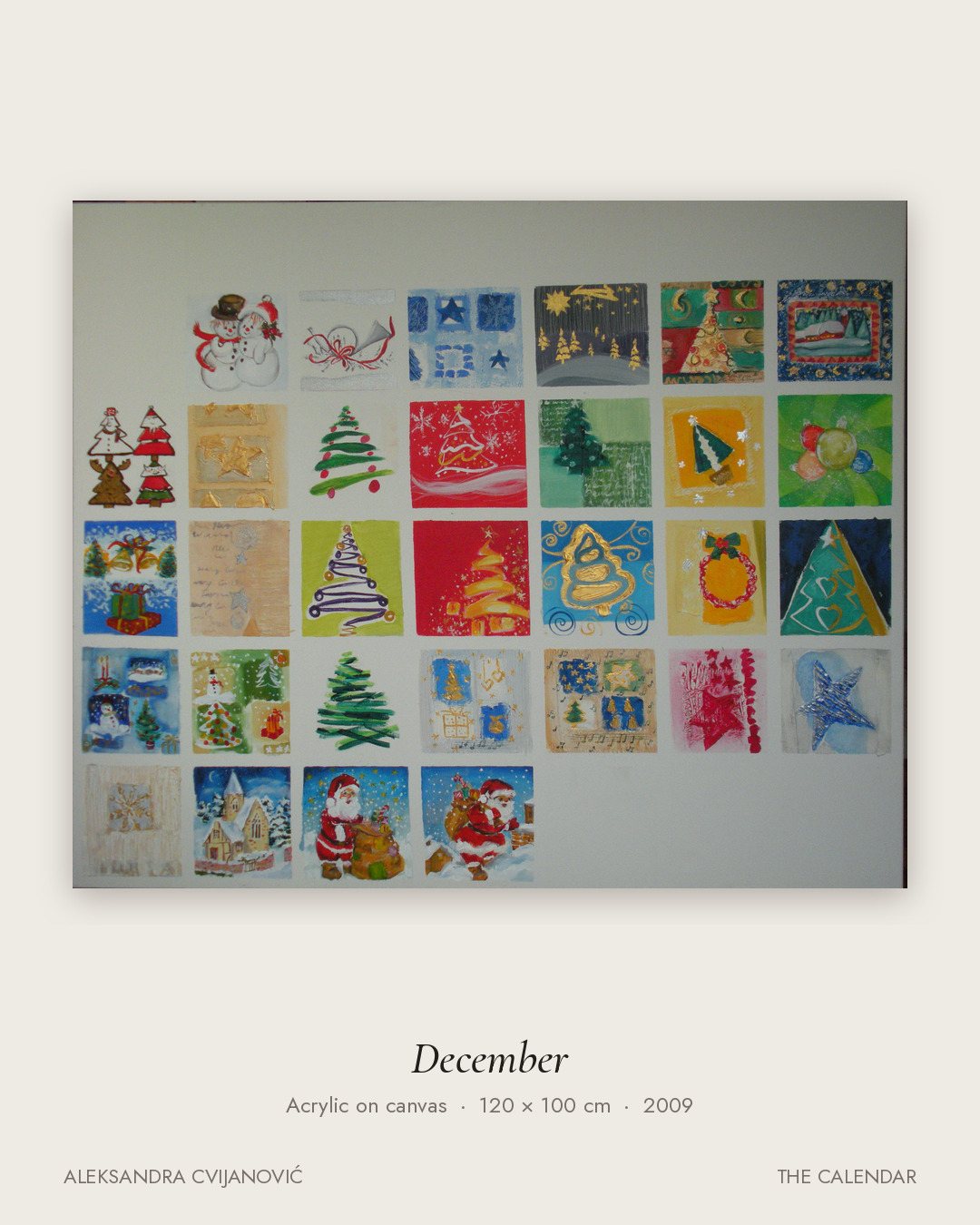
January: a white canvas holding rows of small square paintings, abstract marks in blue, red, black and green.February: small square paintings of cakes, tarts and sweets arranged in rows on a white canvas.March: rows of small portraits of faces in vivid pinks, blues, yellows and greens.April: small paintings like city maps seen from above, in greens, pinks and blues.May: small pale paintings of pill blisters, labels and hospital whites, with touches of red and blue.June: small drawings and paintings in soft greys and whites with accents of red and blue.July: warm, energetic abstract squares in orange, red, yellow and violet.August: small paintings in deep teal and green, with faces and floral motifs.September: muted squares in greys, ochres and blues, some covered in handwriting.October: old portraits, painted plates, wall clocks, a pair of wings and the word LOVE among small squares.November: letters of the Cyrillic alphabet painted in colour and gold leaf.December: small holiday cards with Christmas trees, stars, snowmen and Santa Claus.

The Calendar, twelve months on one wall.

Each canvas is a month, built day by day from small paintings: a personal record of hopes, disruptions and small joys. Swipe from January to December.

From every month one painted day also stands on its own, at 30 × 30 cm.

The Calendar, 2009. Acrylic on canvas, 120 × 100 cm each.

See The Calendar in person at World Art Dubai, 19–22 November, Dubai World Trade Centre, stand OB04.
For inquiries: cvijanovic.aleksart@gmail.com · cvijanovicaleks.art

Art Kitchen, continued

Art Kitchen, continued: fourteen more works from the studio.

A found object study, The Wheel, and a mixed media Facebook. Two Perspective works in Xerox transfer. People and the diptych Behind in combined technique. Untitled acrylics on canvas and two untitled ships in combined technique. Three Marocco canvases and a pair of Postcards.

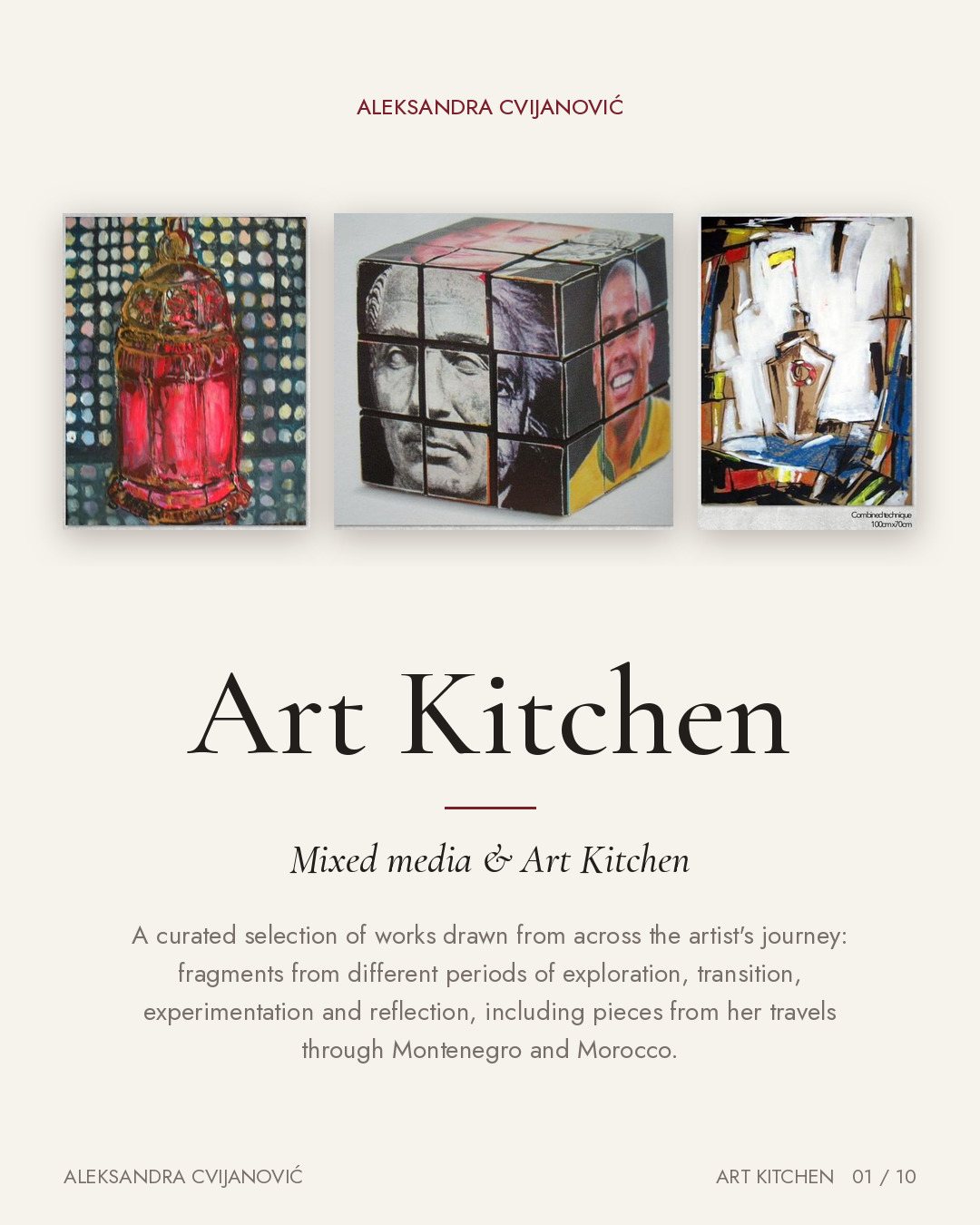
Art Kitchen gathers fragments from different periods of Aleksandra Cvijanović's work: moments of exploration, transition, experimentation and reflection that have shaped her visual language over time.

For inquiries: cvijanovic.aleksart@gmail.com · cvijanovicaleks.art

The Calendar · November

November, in letters.

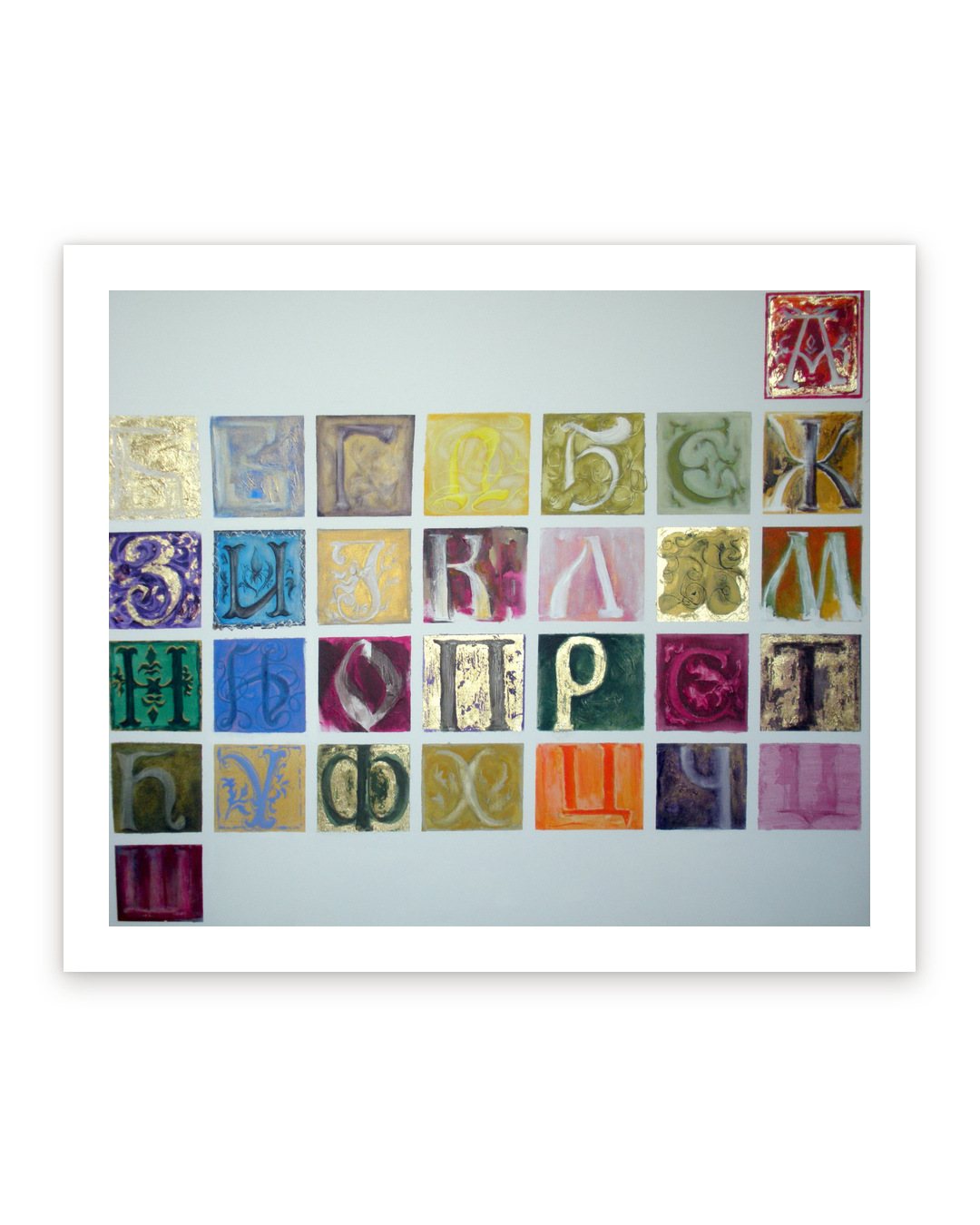
Thirty small paintings, one for every day of the month, laid out on the canvas like a page of a calendar. Here each day is a letter of the Serbian Cyrillic alphabet: the first, А, sits alone at the top in red and gold, and the rest follow in rows, each in its own colour, several of them in gold. One of its days, the 18th of November, also stands on its own as a separate painting: a pale, almond-shaped form on deep magenta.

The art historian Marija Milenković reads November as a gloomy, heavy month that brings an alphabet of life and of language, a letter of love and a glossary of every day. Each letter, she writes, carries thousands of words, a certain tone and symbol, and a handful of possibilities: the making of a future language of tradition.

November, from The Calendar. Acrylic on canvas, 120 × 100 cm, 2009. The 18th of November, acrylic on canvas, 30 × 30 cm.

See The Calendar in person at World Art Dubai, 19–22 November, Dubai World Trade Centre, stand OB04.
For inquiries: cvijanovic.aleksart@gmail.com · cvijanovicaleks.art

Art Kitchen

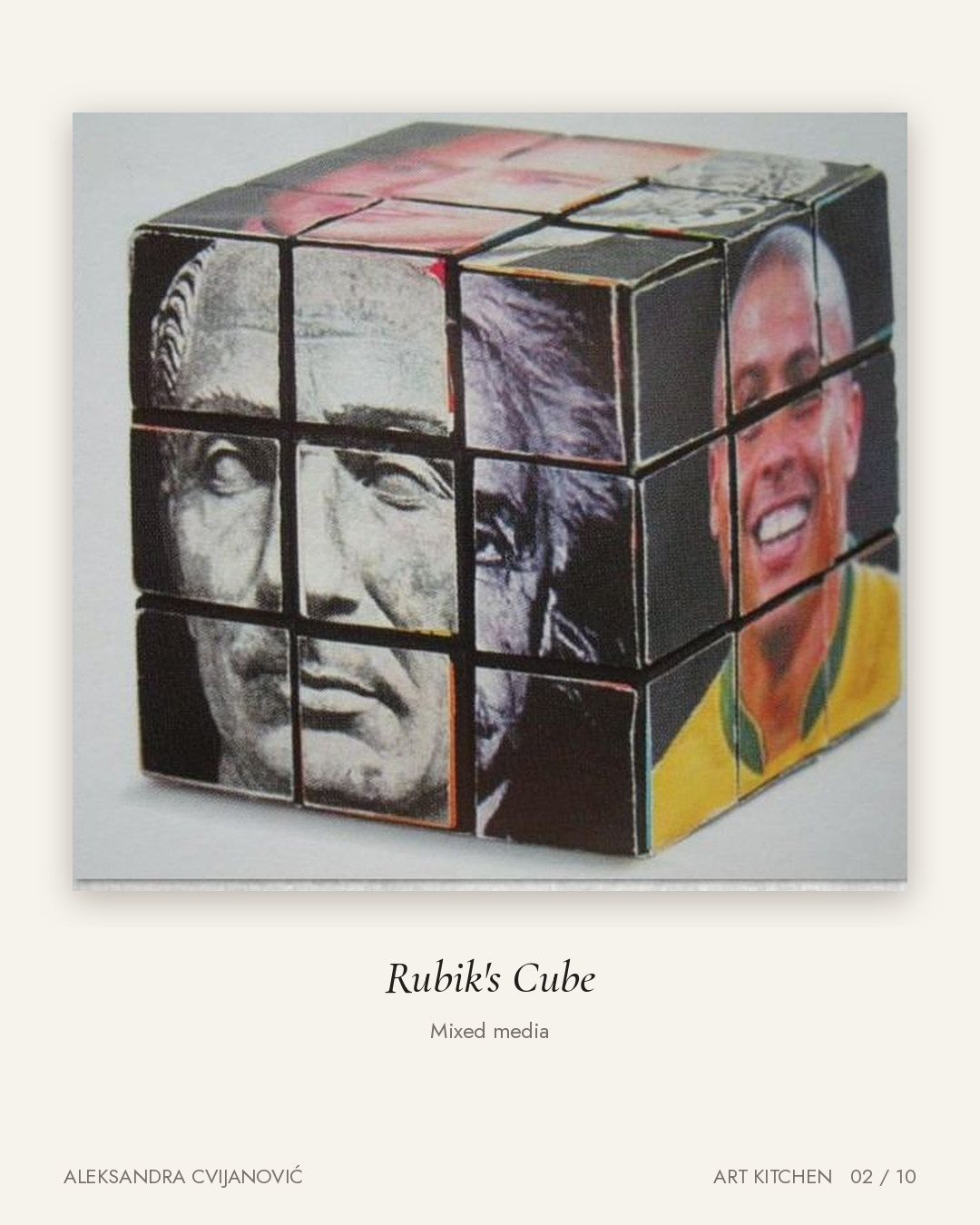
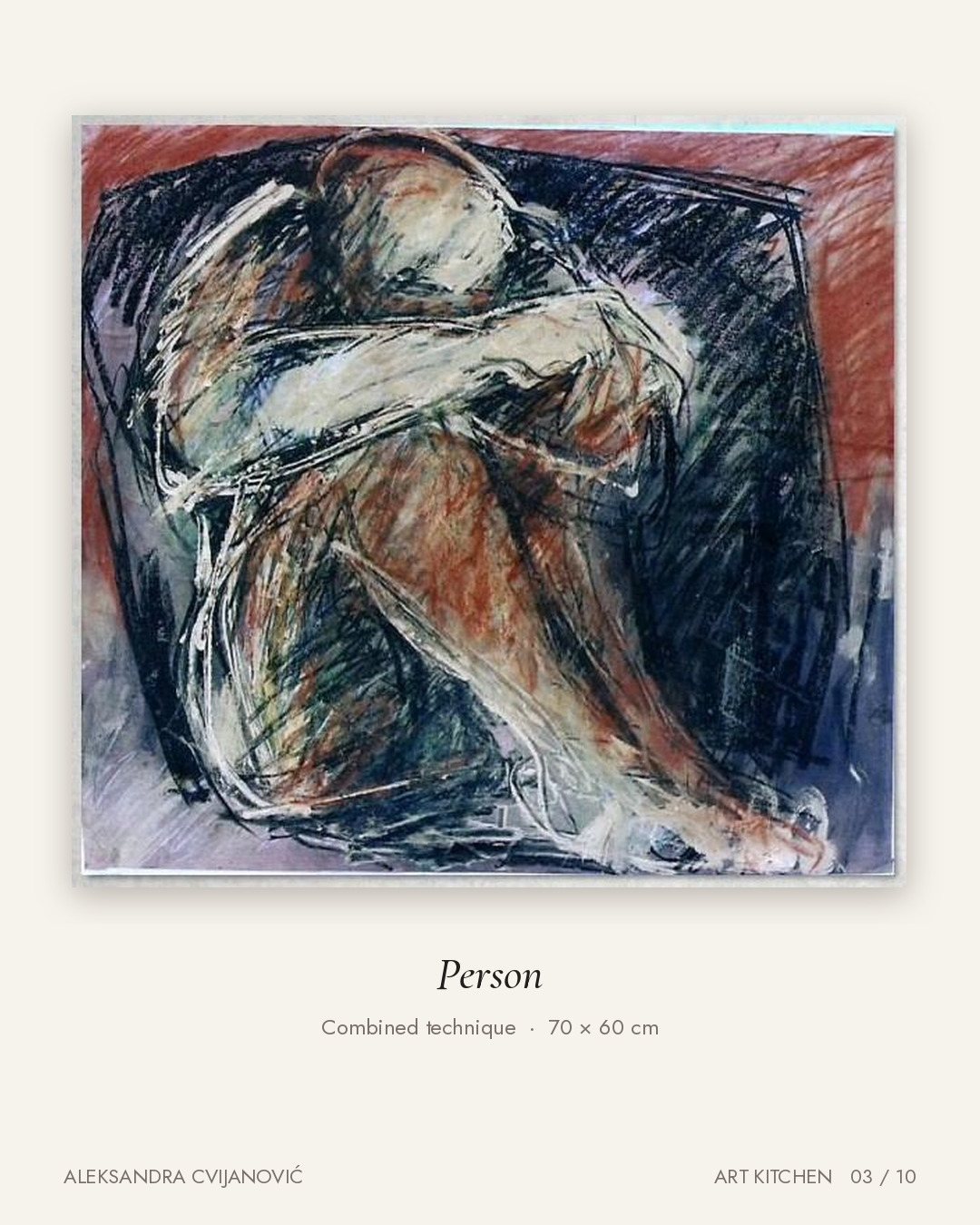
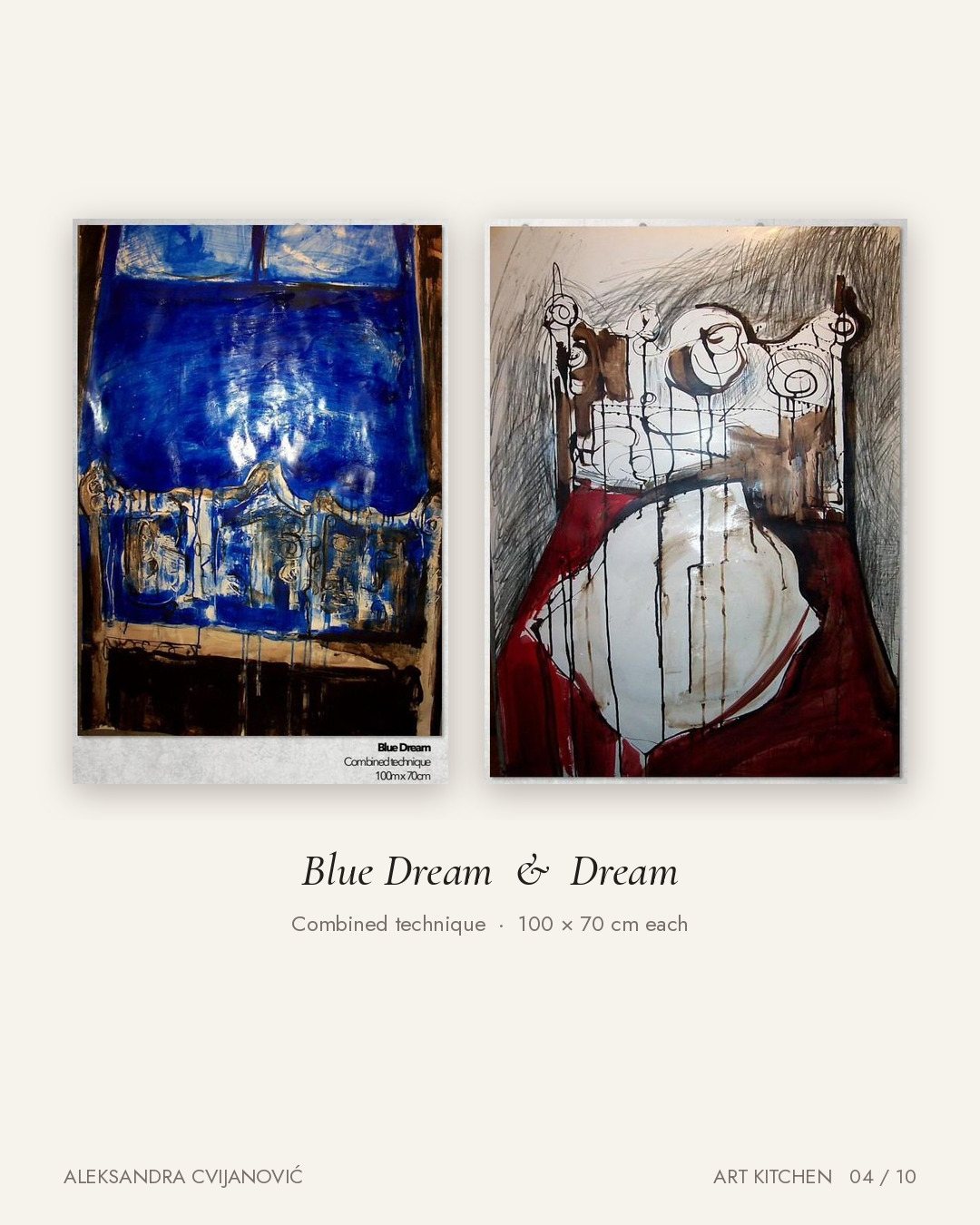
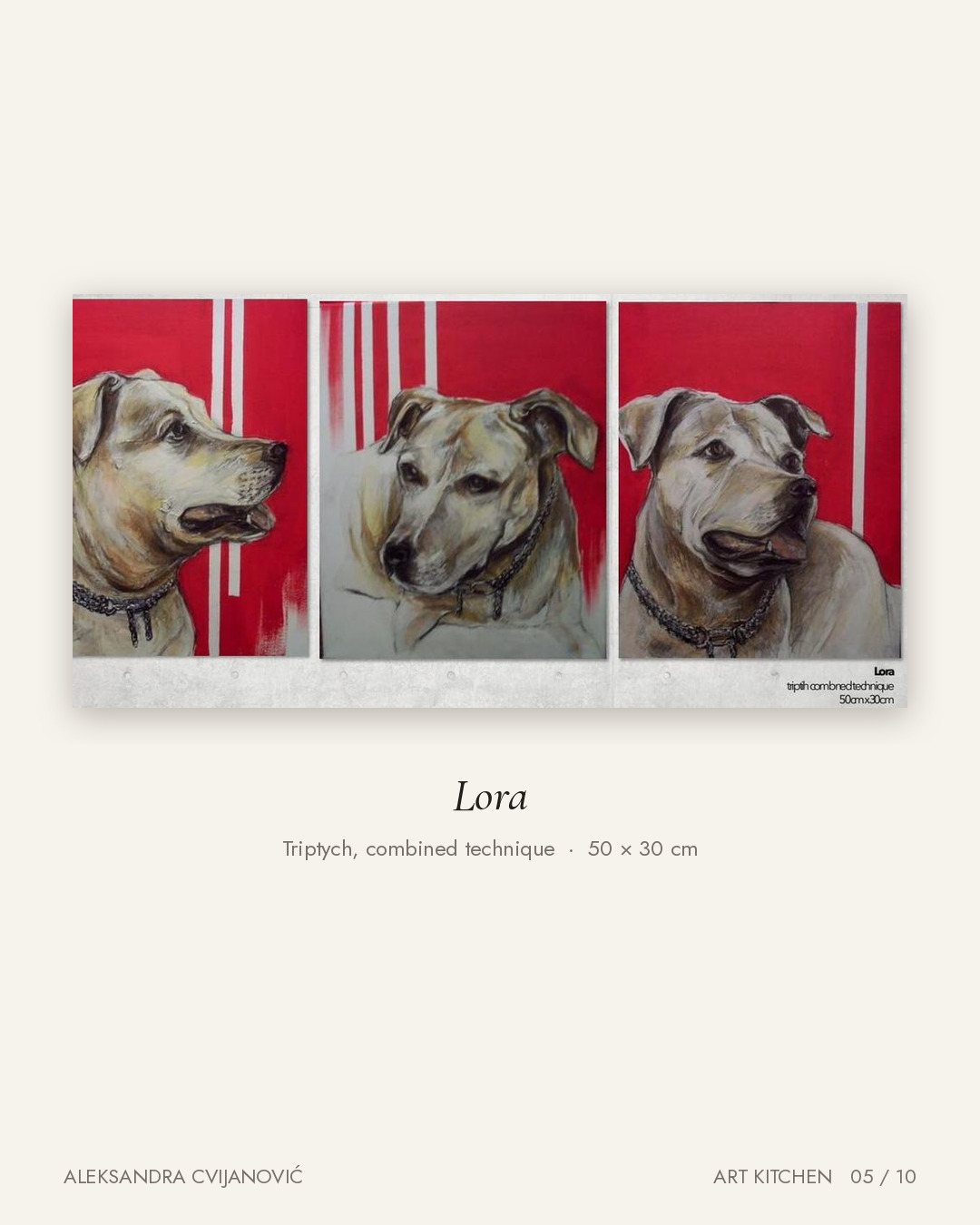
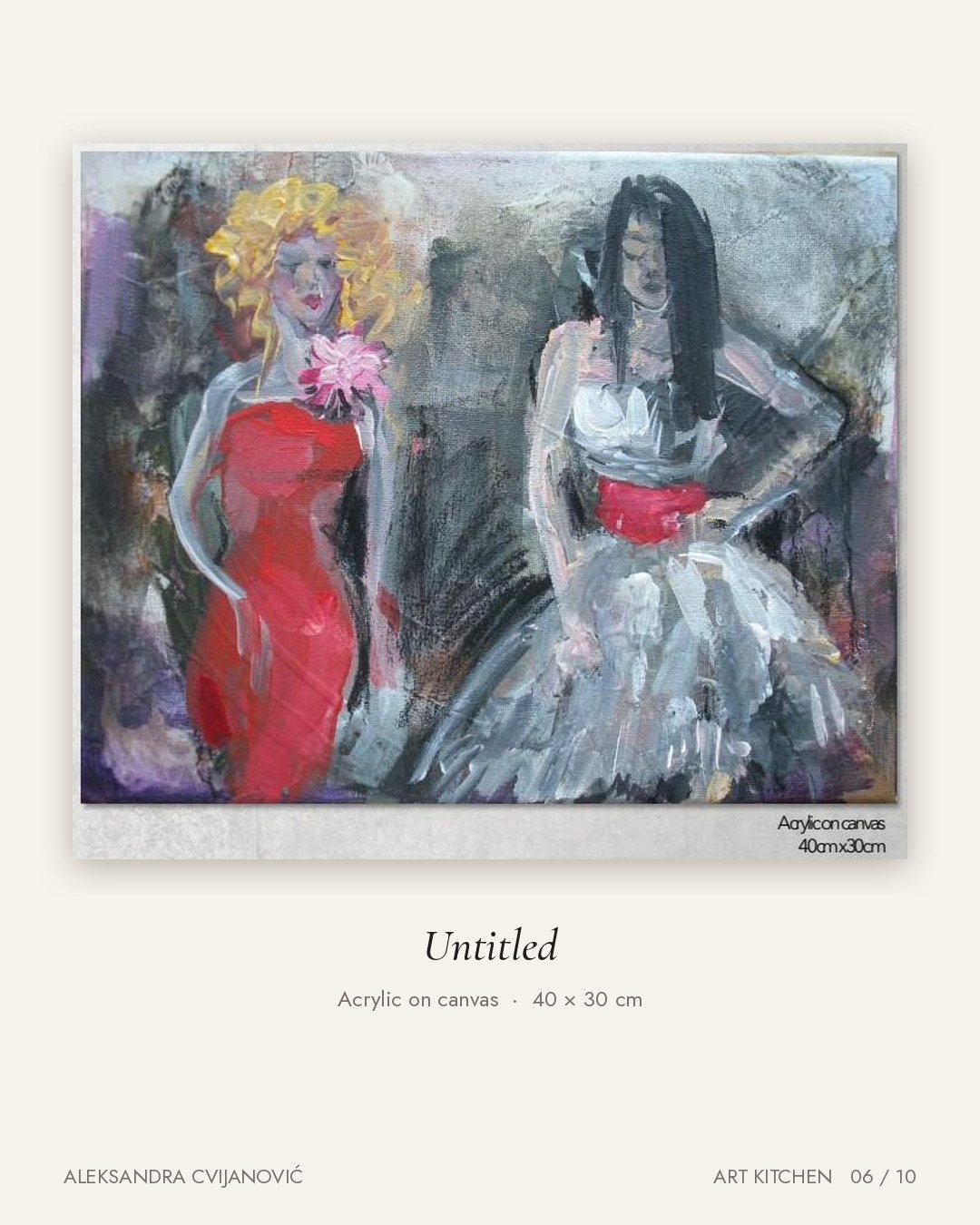
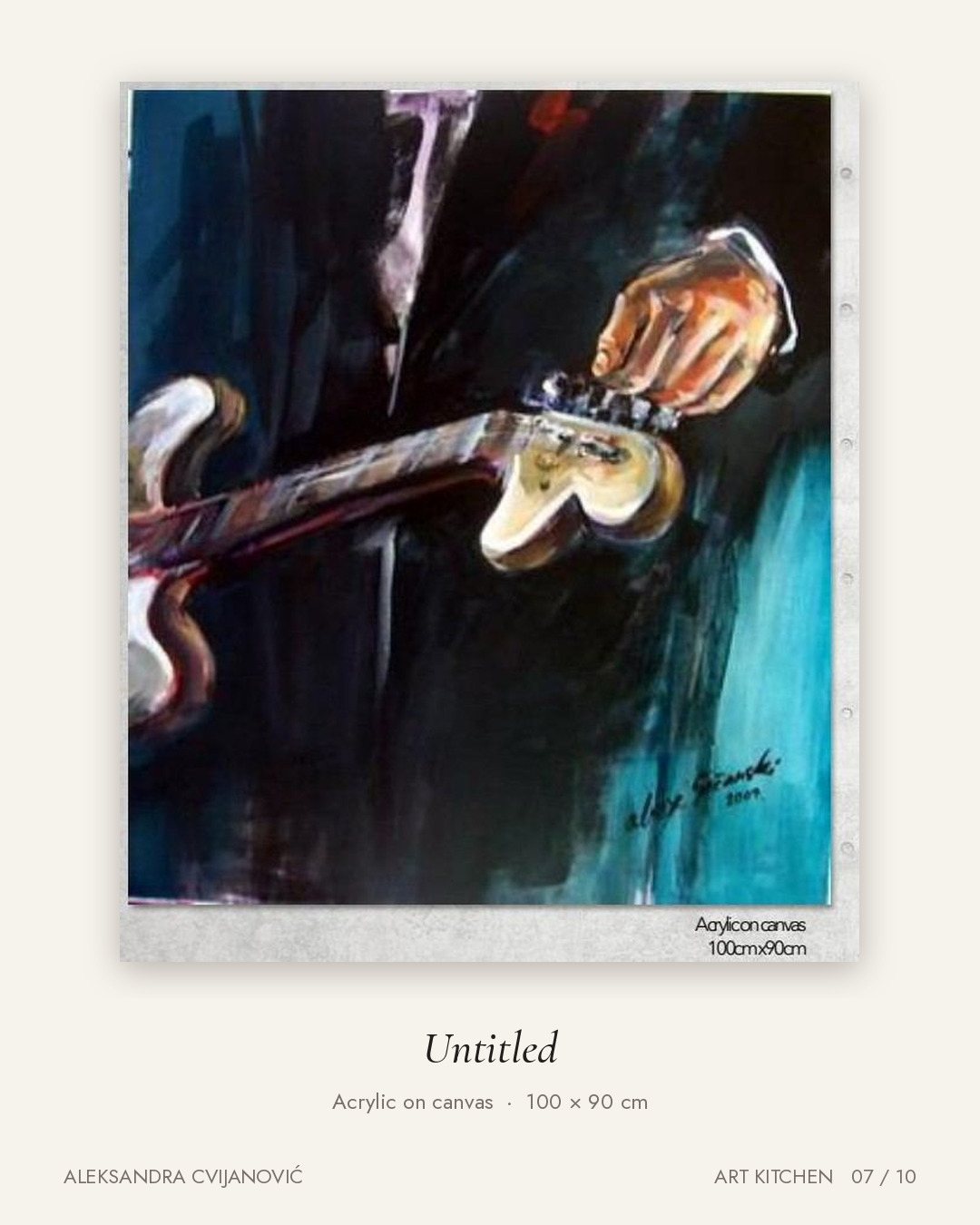
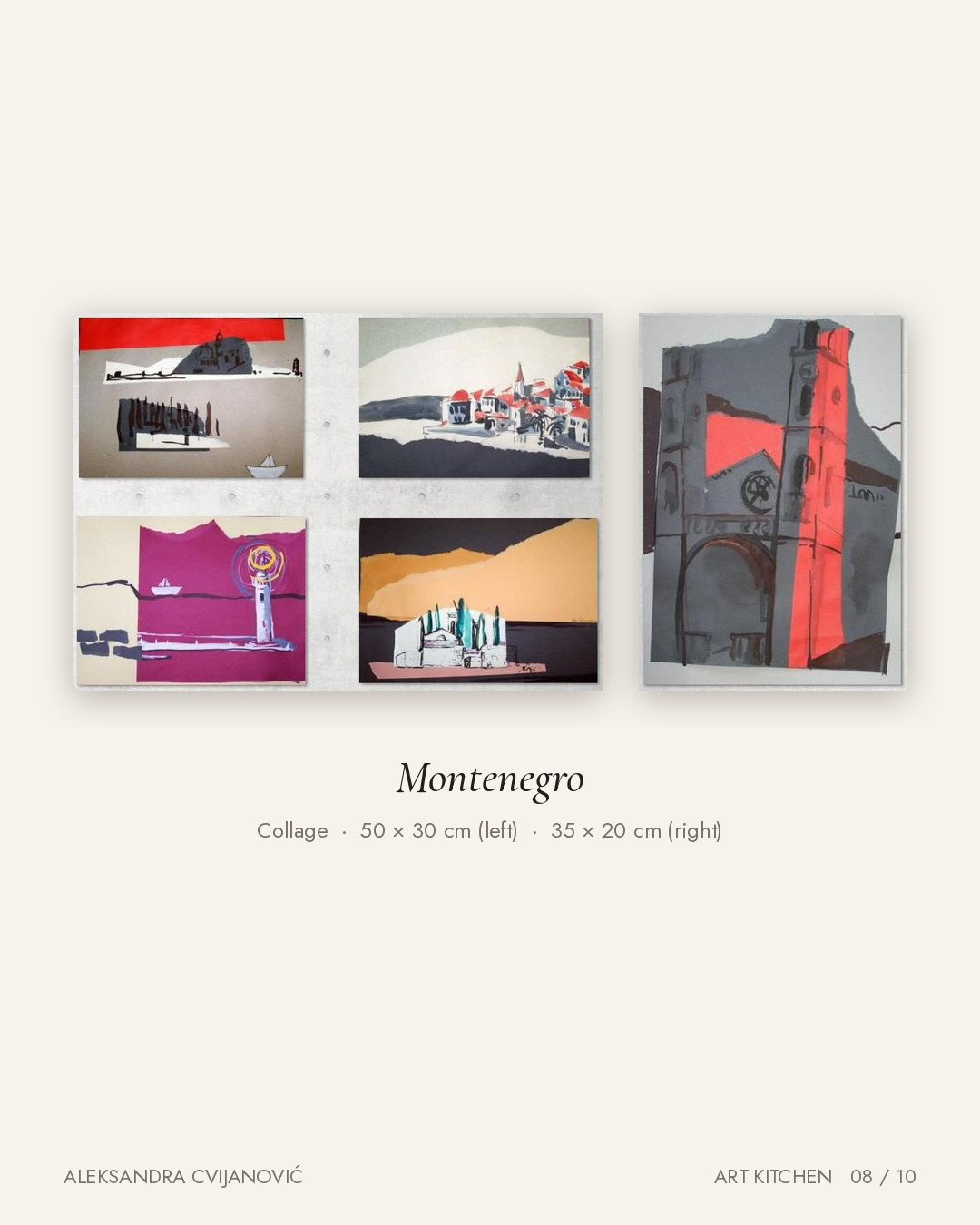
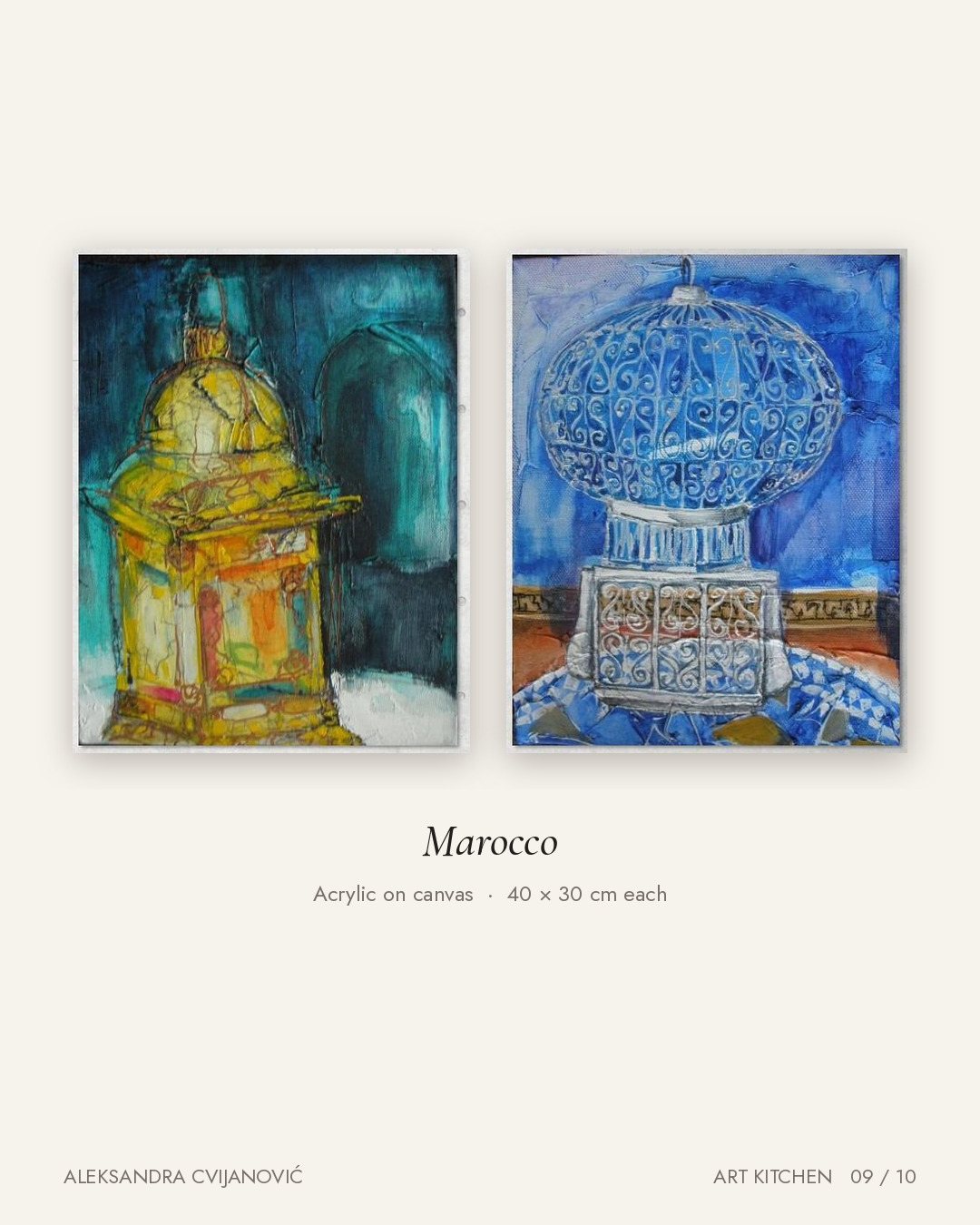
Cover: three works above the title Art Kitchen and a short introductionRubik's Cube, mixed media: a cube whose faces carry printed portraitsPerson, combined technique: a crouching figure in expressive dark and red strokesBlue Dream and Dream, combined technique, side by side: a deep blue bed and a red and white bedLora, triptych in combined technique: three portraits of a dog against redUntitled, acrylic on canvas: two women in red and white dressesUntitled, acrylic on canvas: a hand playing a guitar on a dark and turquoise groundTwo Montenegro collages: coastal scenes in torn paper and a grey and red church facadeTwo Marocco acrylics: a yellow lantern and a blue lanternClosing slide: For inquiries with email and website, and Follow the studio @cvijanovic.aleksart

Art Kitchen: fragments from a long journey.

"Art Kitchen is a curated selection of works drawn from various cycles throughout my artistic journey. Rather than representing a single, self-contained series, this section brings together fragments from different periods: moments of exploration, transition, experimentation, and reflection that have shaped my visual language over time." Aleksandra Cvijanović

A mixed media Rubik's Cube, figures and portraits in combined technique, acrylics on canvas, collages from Montenegro and lanterns from Morocco. Eleven works in one carousel.

For inquiries: cvijanovic.aleksart@gmail.com · cvijanovicaleks.art

The Mask · The peaks of Kilimanjaro

The peaks of Kilimanjaro.

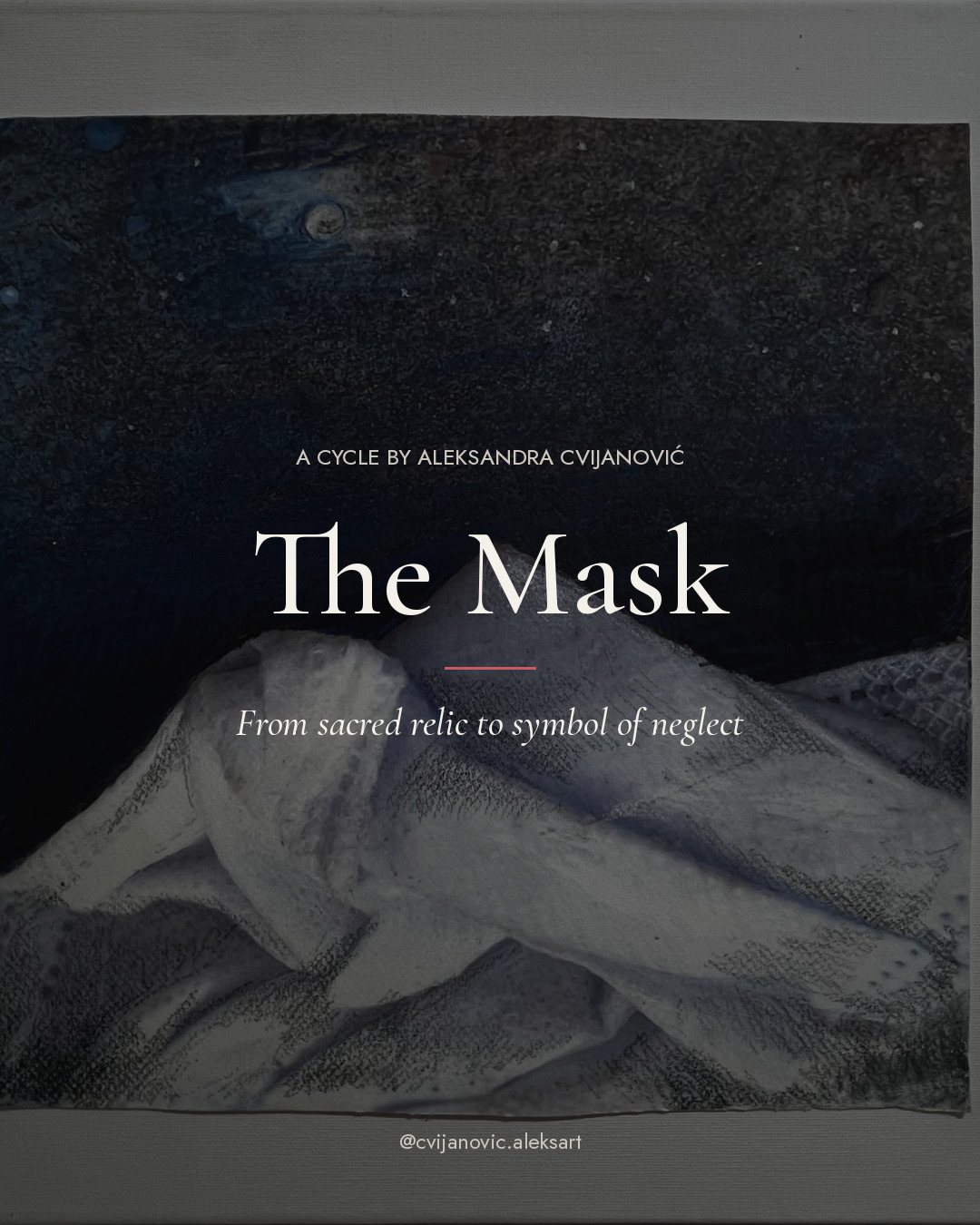
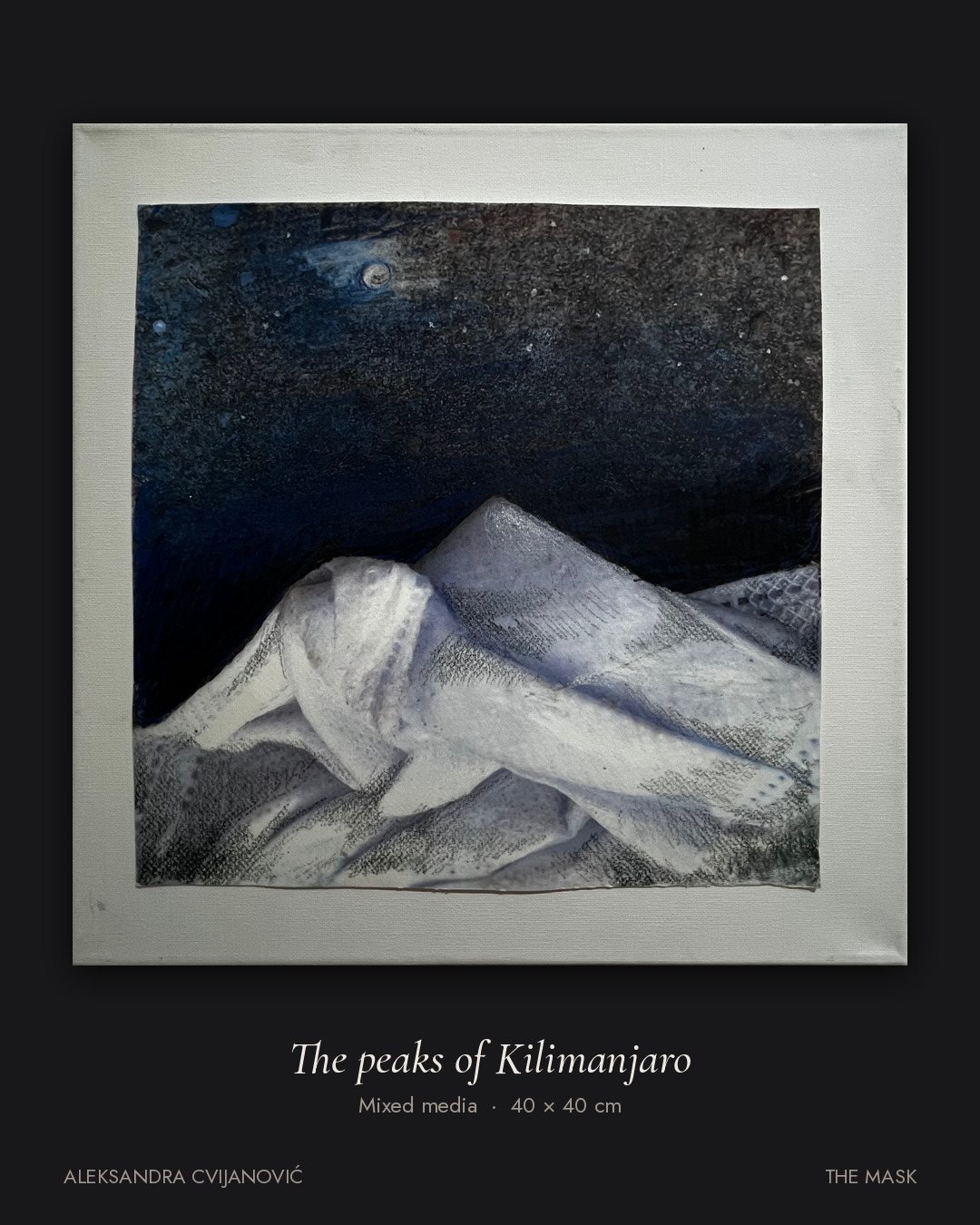
Under a night sky with a small moon and a few stars, a crumpled white mask rises into a range of snowy peaks. Its folds become ridges, and fine hatched lines give them shadow and weight.

Like every work in The Mask, it starts from a scene of an abandoned mask and is finished with acrylic detail. Something made to be worn once and thrown away becomes, for a moment, a mountain. Where does it go after that?

The peaks of Kilimanjaro, from The Mask. Mixed media, 40 × 40 cm.

For inquiries: cvijanovic.aleksart@gmail.com · cvijanovicaleks.art

The Calendar · October

October, in the letter O.

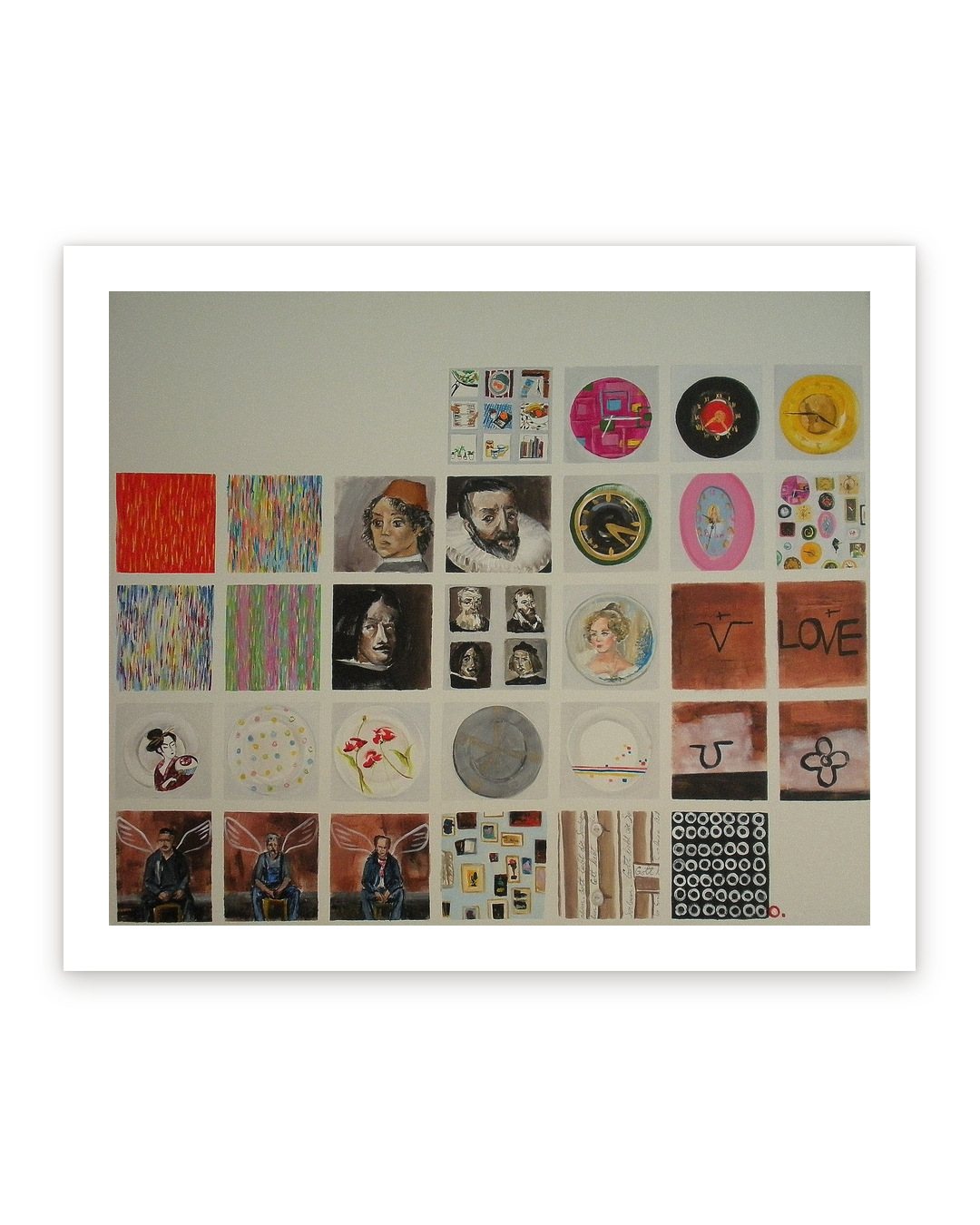
Thirty-one small paintings, one for every day, laid out on the canvas like a page of a calendar. October gathers faces from old portraits, painted plates and wall clocks, a pair of wings, a few signs and a single word: LOVE. One of its days, the 21st of October, also stands on its own as a separate painting: three red poppies on a pale blue plate.

The art historian Marija Milenković reads October in a string of phrases that, in Serbian, all begin with the letter O: an original October, a homage to all things October, an observation of circumstances, the objectivity of the obvious, a landmark and a mirror that revokes the ordinary.

October, from The Calendar. Acrylic on canvas, 120 × 100 cm, 2009. The 21st of October, acrylic on canvas, 30 × 30 cm.

See The Calendar in person at World Art Dubai, 19–22 November, Dubai World Trade Centre, stand OB04.
For inquiries: cvijanovic.aleksart@gmail.com · cvijanovicaleks.art

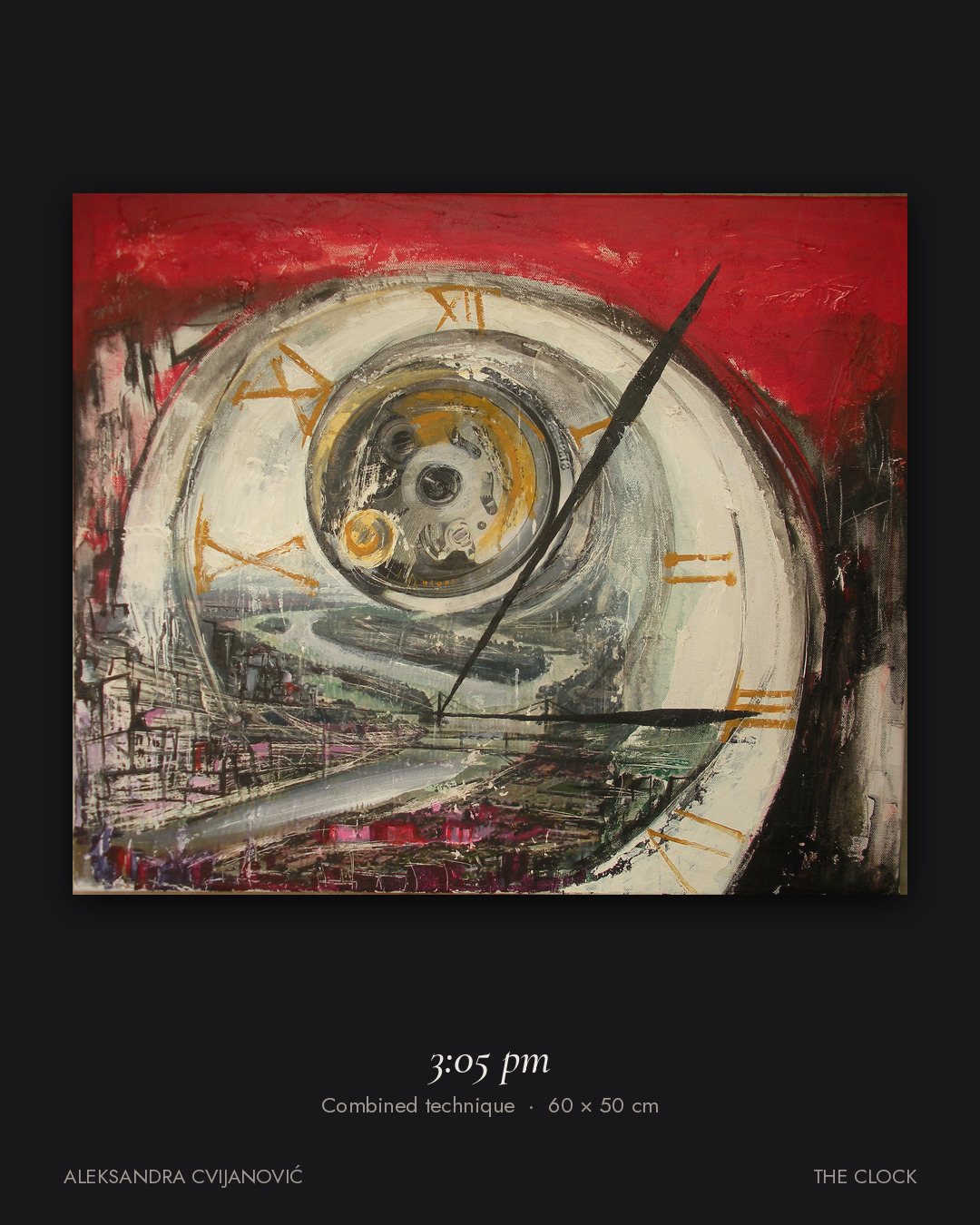
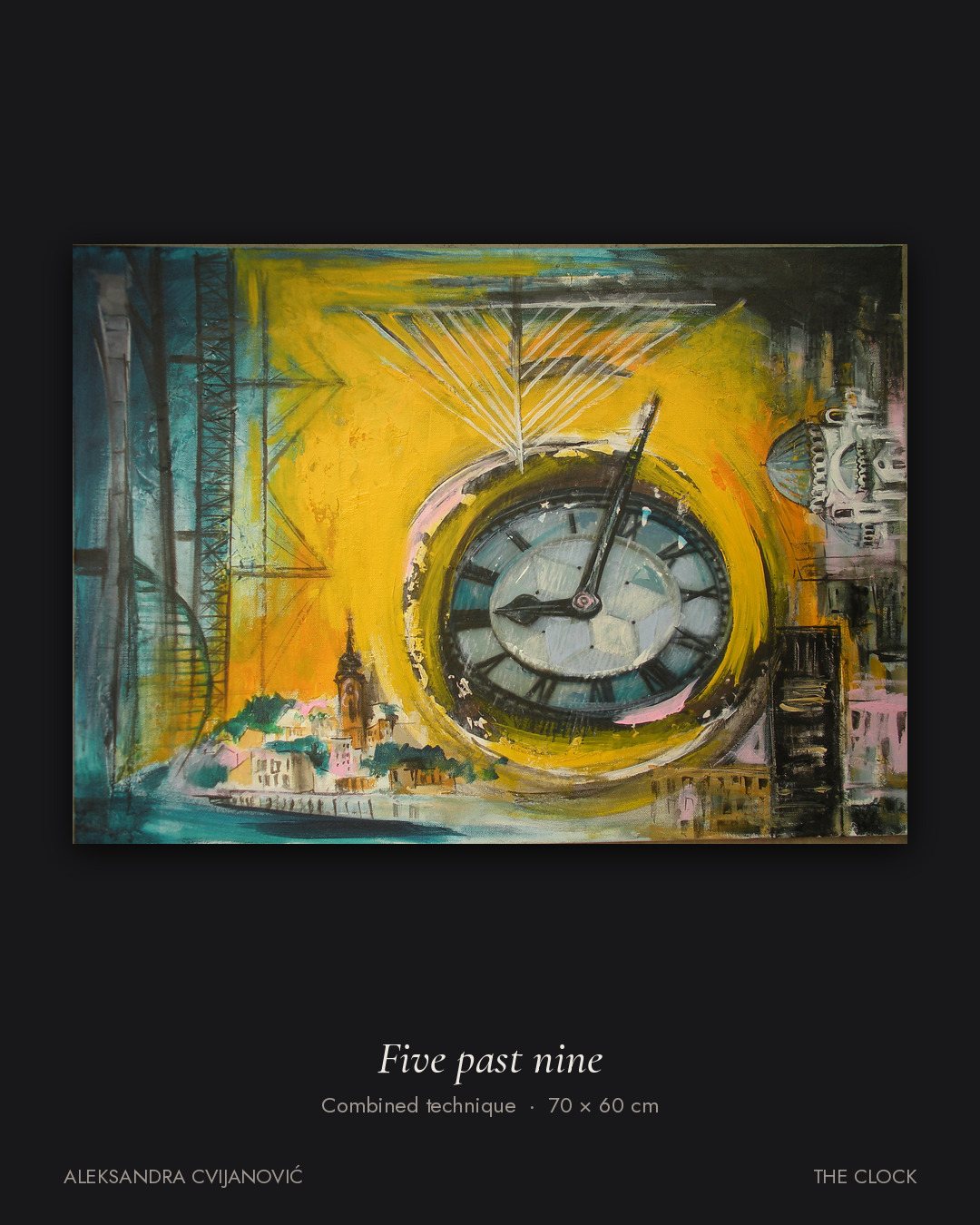
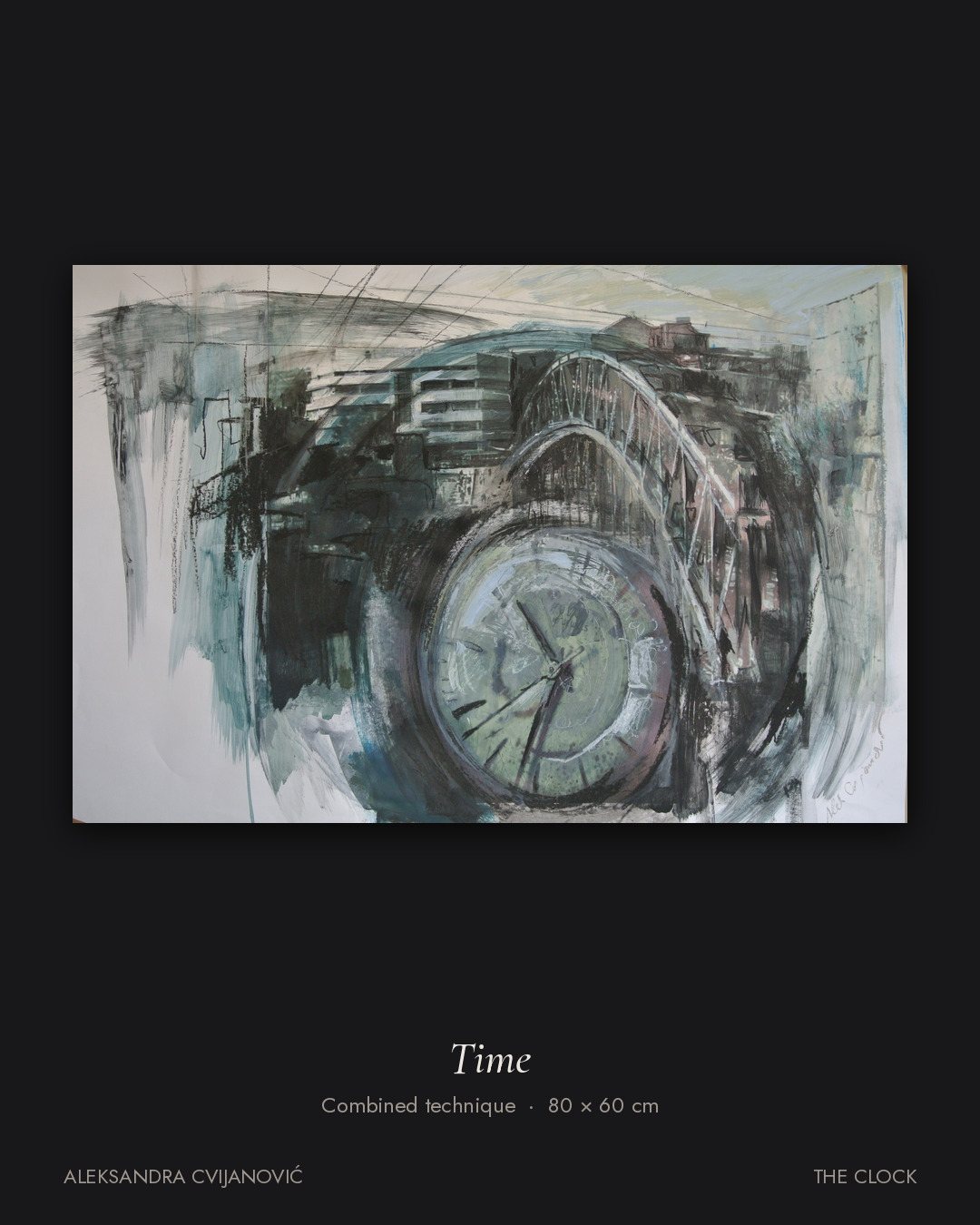
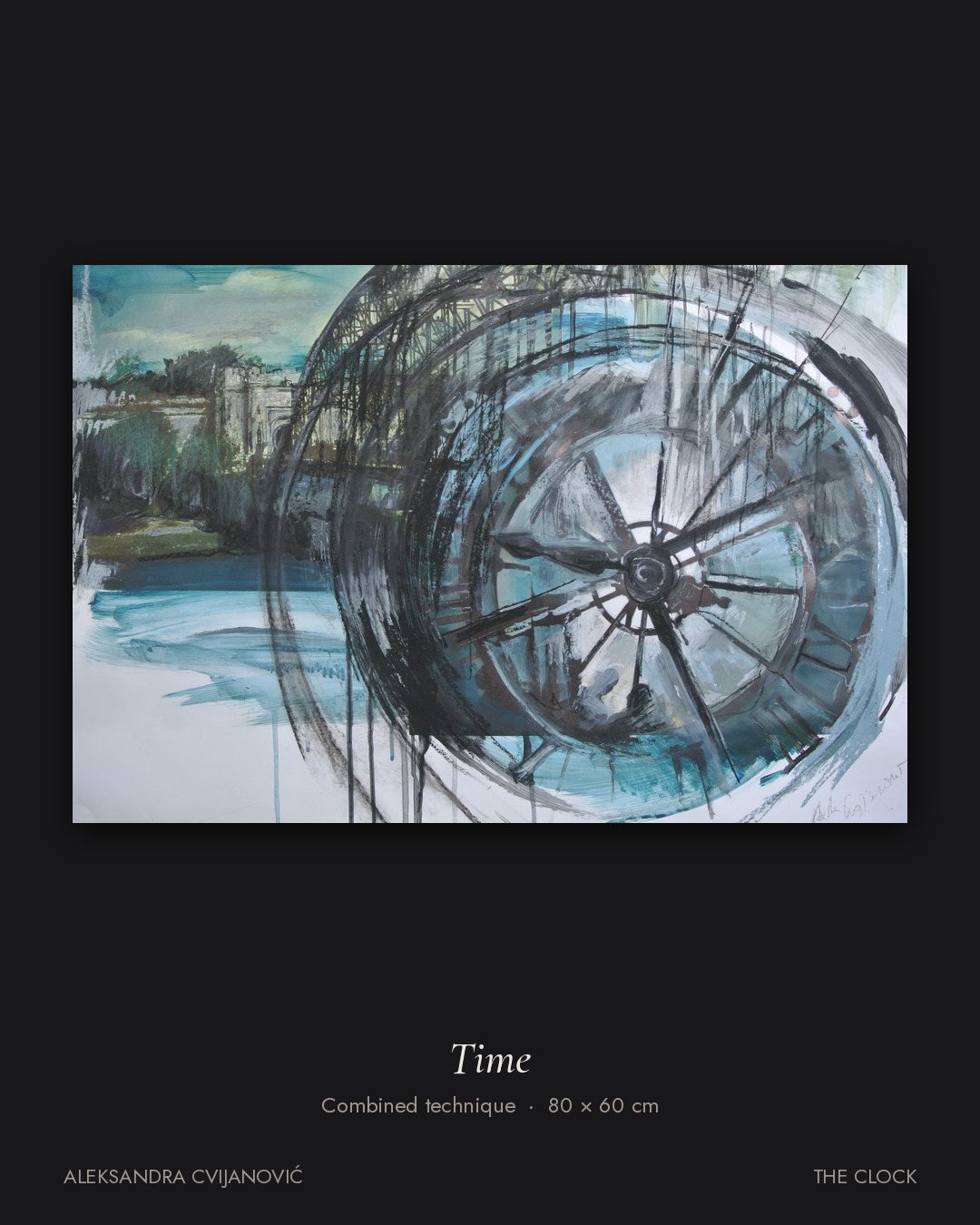
The Clock · the whole cycle (Time)

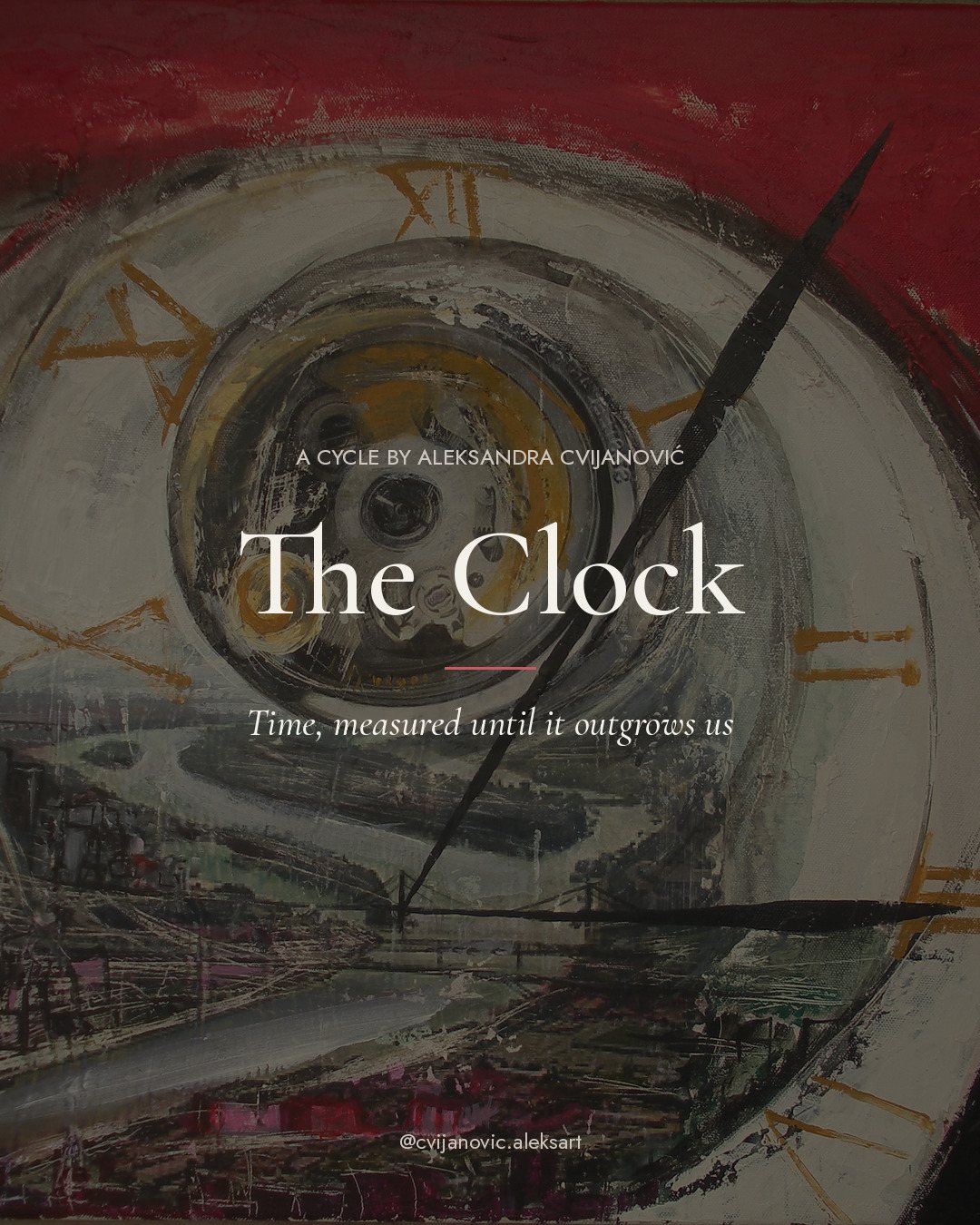
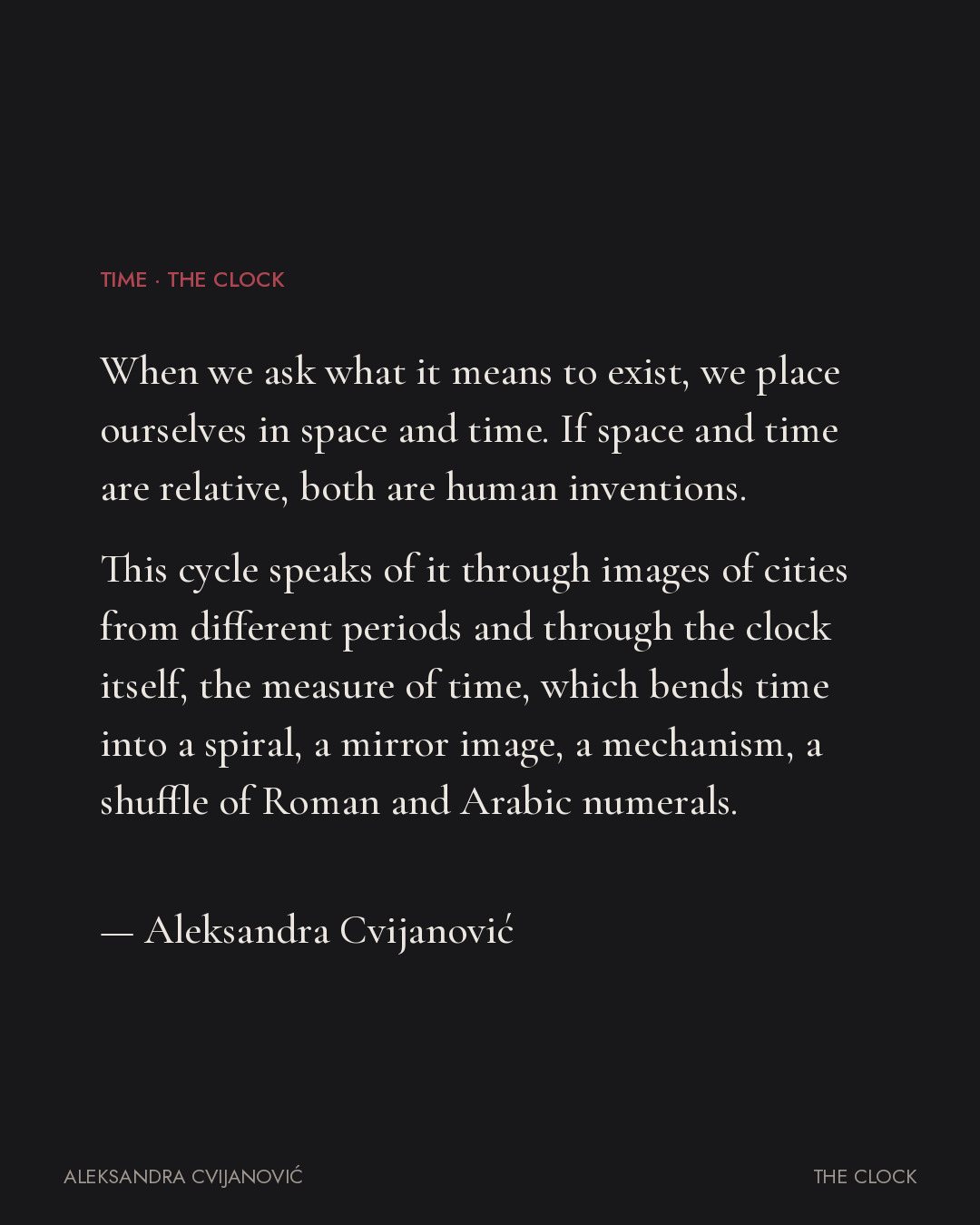
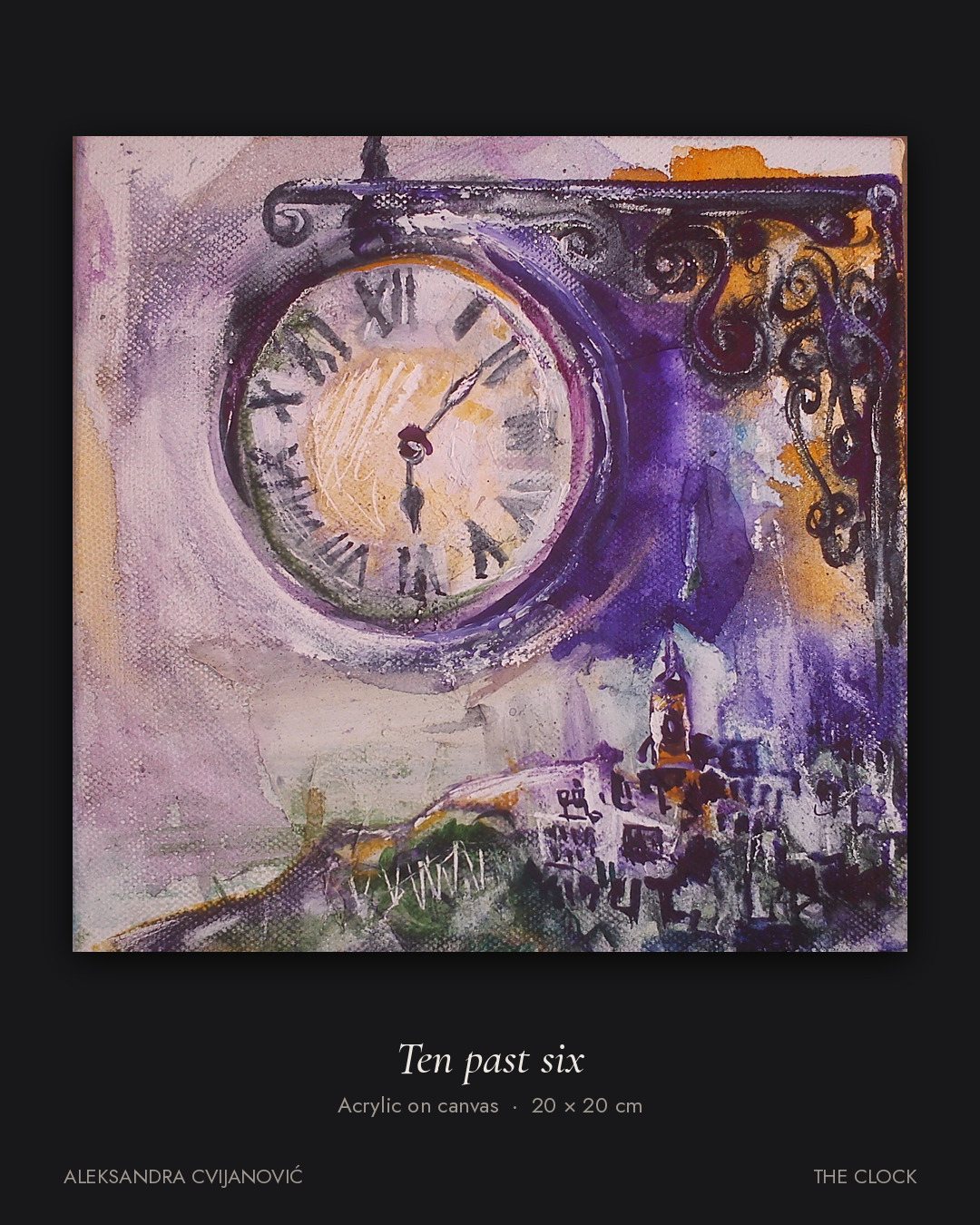
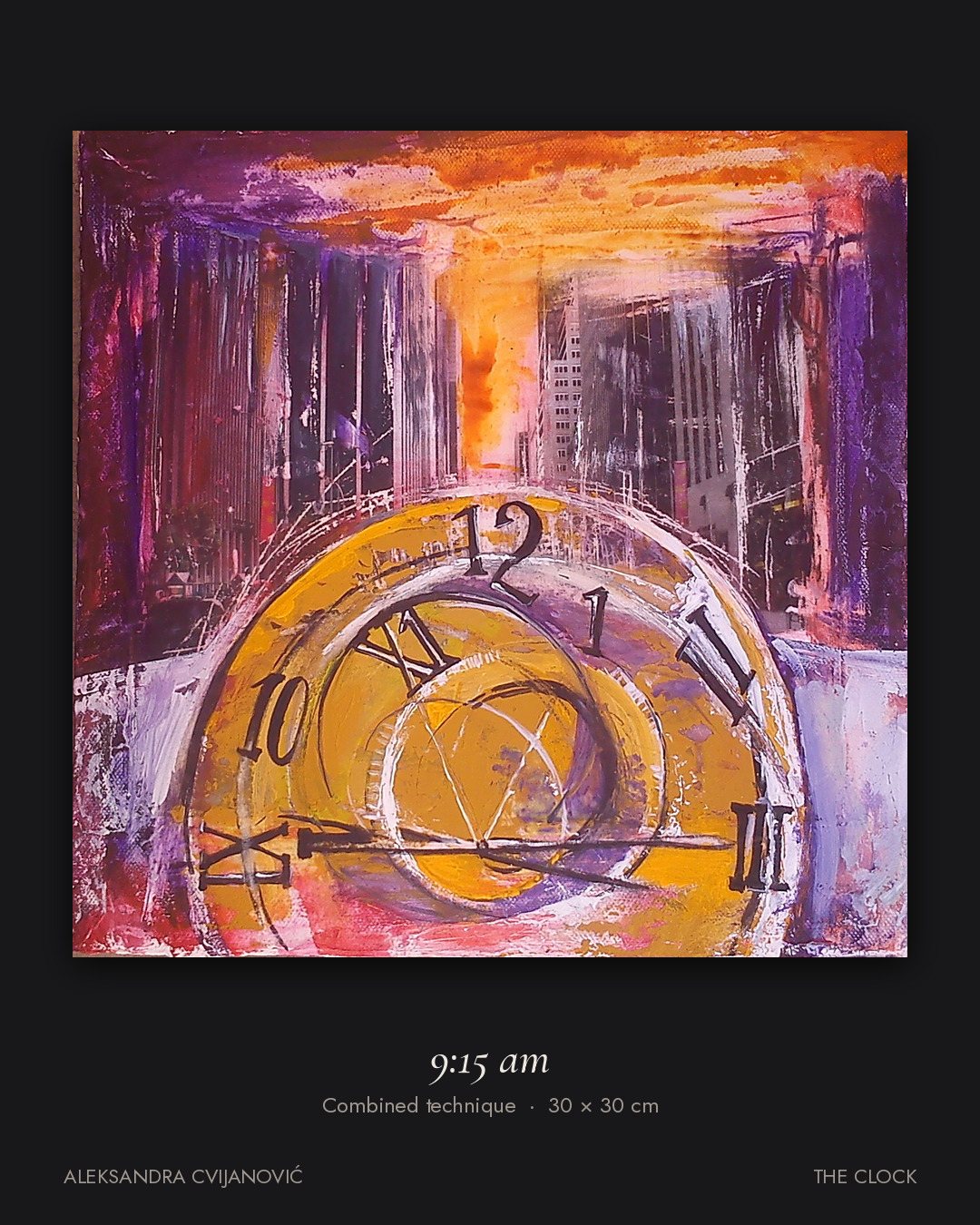
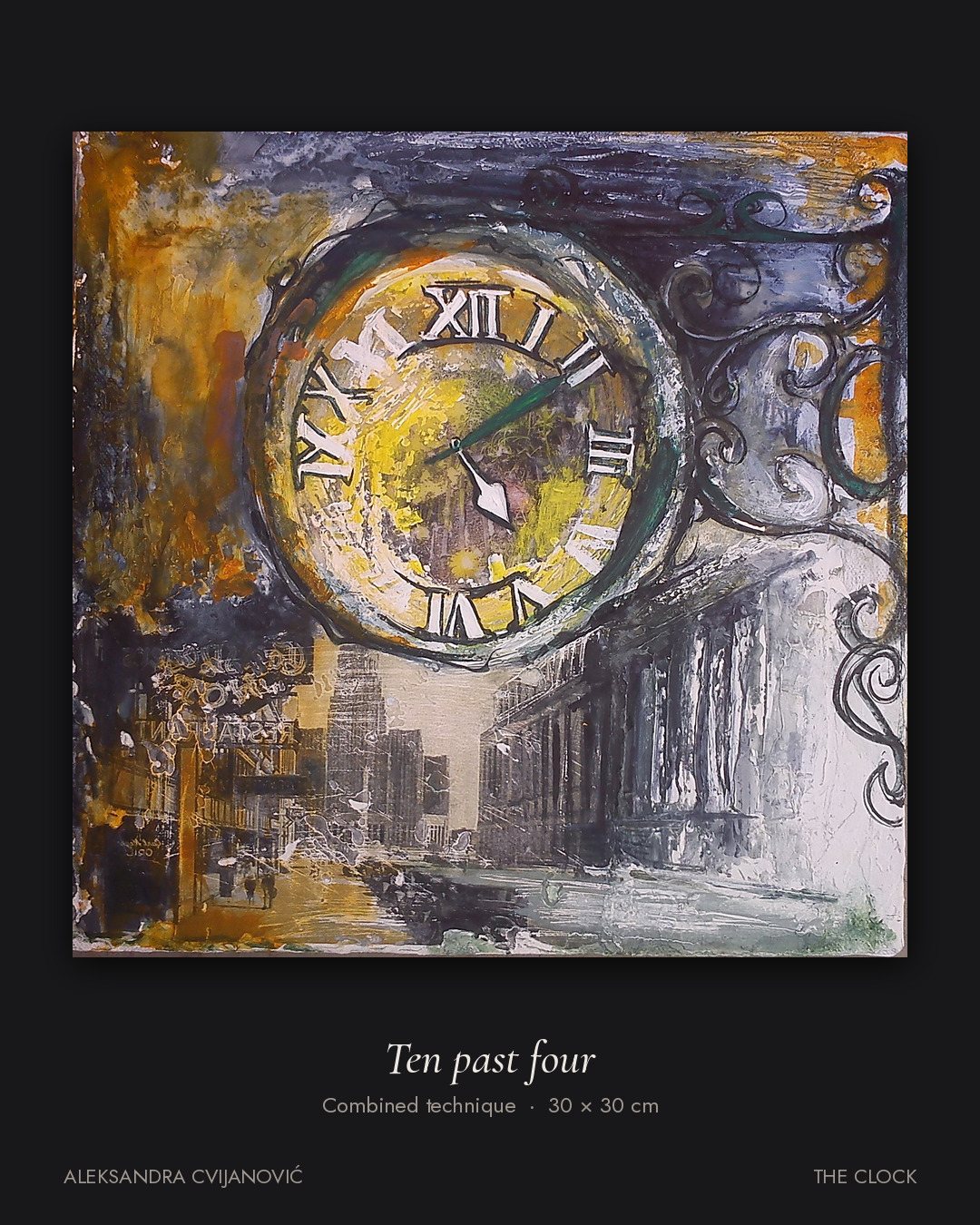
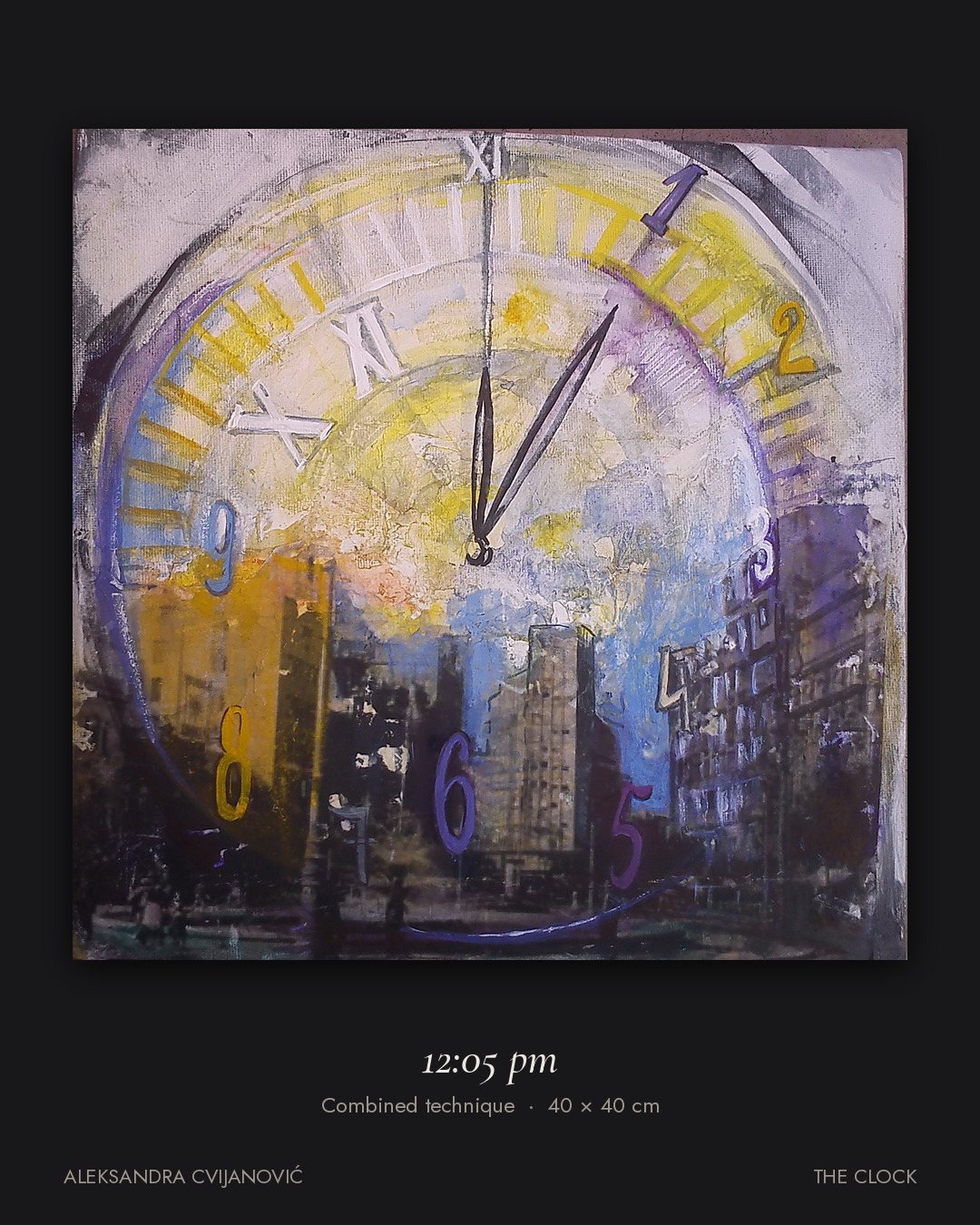
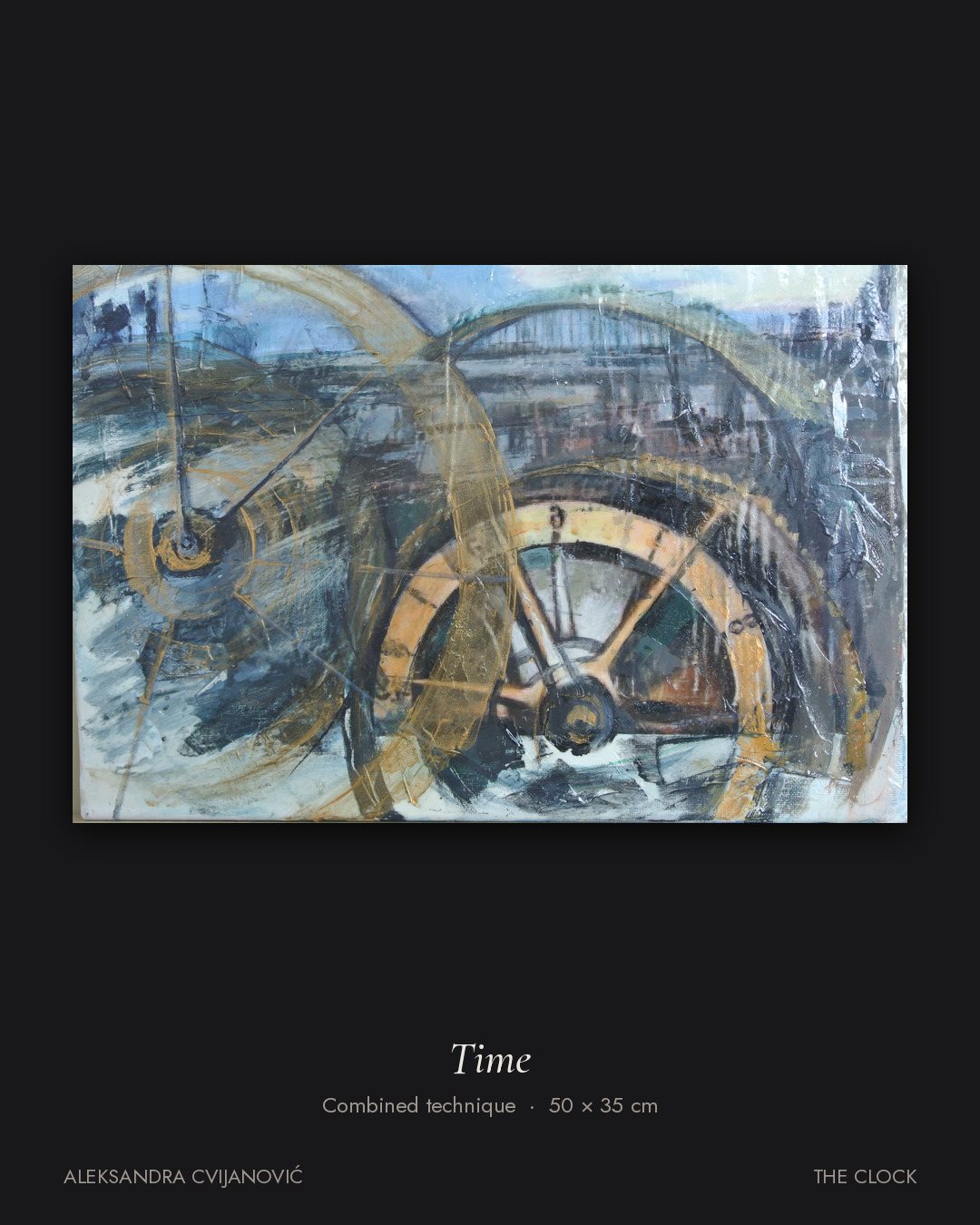
Cover: The Clock, a cycle by Aleksandra Cvijanović, over a darkened detail of a large clock face in white, red and gold.Text slide: Aleksandra Cvijanović's statement on the cycle, about space, time and the clock as the measure of time.Ten past six: a large Roman-numeral street clock on an ornate iron bracket, in violet and white, above a small hilltop town.9:15 am: a tilted orange clock face with black numerals in front of tall purple and orange city towers.Ten past four: a street clock with Roman numerals on a curling iron bracket, in ochre and grey, over city buildings and streets.12:05 pm: a huge clock face in yellow and violet with both hands near twelve, rising over a dark city skyline with scattered blue numerals.Time: grey-blue city scenes and bridges behind golden clockwork wheels and a clock dial, painted in loose strokes.3:05 pm: a spiralling white and gold clock face with a long black hand over a red ground and a dim landscape.Five past nine: a clock face set into a bright yellow sun-like circle above a river and a city with towers, framed in dark teal.Time: a pale clock face with dark hands set among sketchy grey buildings and arches, in black, white and blue-green.Time: a large spoked clock wheel drawn in black lines over a river landscape in blue and teal.Text slide: the cycle has 24 works hung from the smallest to the largest, with a quotation from Ivo Andrić.

Time, The Clock.

Old photographs and the silhouettes of familiar cities turn into clocks: the instrument we invented to measure time, and the one that ends up measuring us.

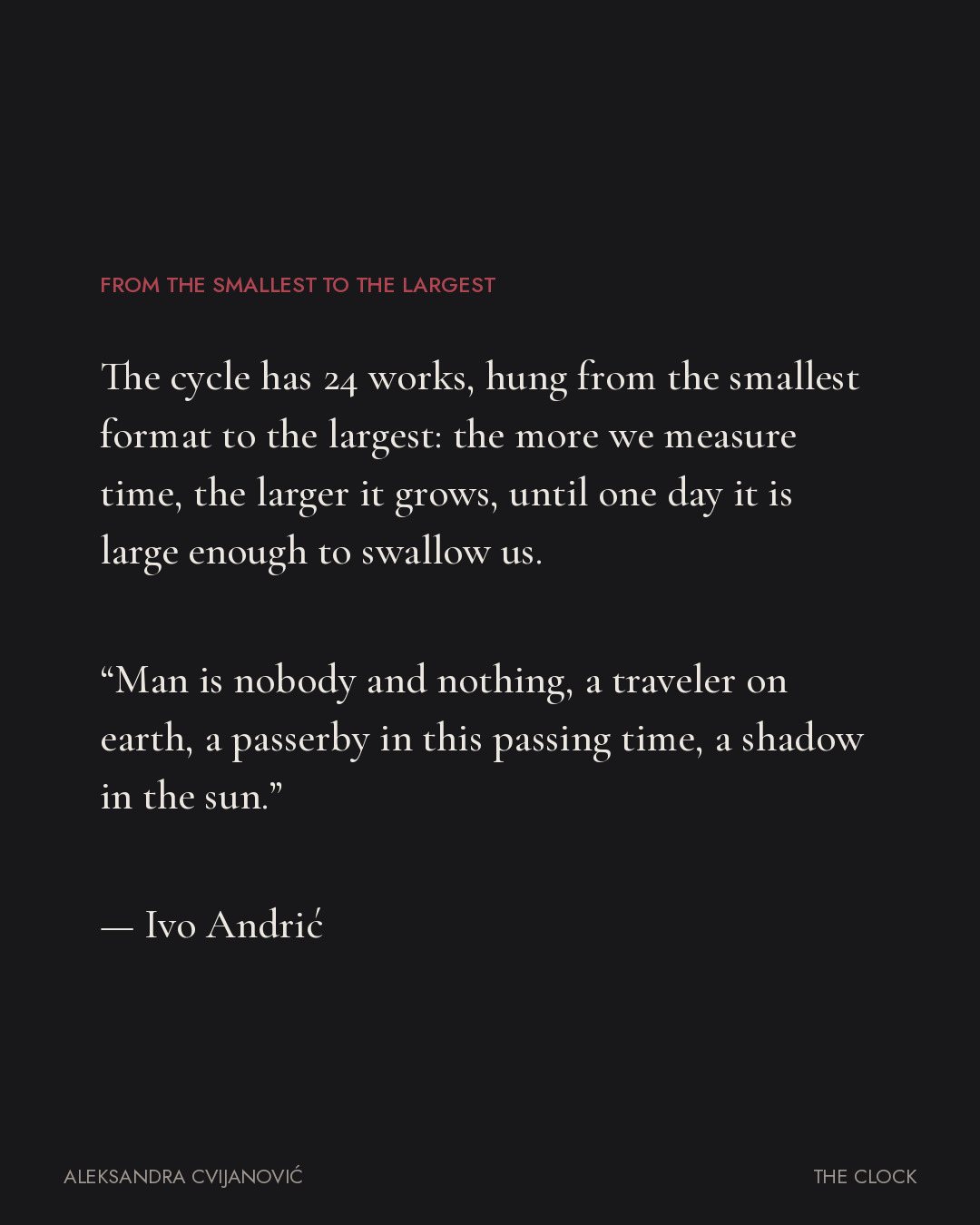
The cycle has 24 works in combined technique, acrylic on canvas with Xerox transfer. Clock faces bend into spirals, mirror images and mechanisms, and Roman and Arabic numerals change places. Aleksandra conceived the works to be hung from the smallest format to the largest, so that time keeps growing the more we measure it, until it becomes large enough to swallow us. This carousel follows the same order, from a 20 × 20 cm canvas to two works of 80 × 60 cm.

"Man is nobody and nothing, a traveler on earth, a passerby in this passing time, a shadow in the sun." Ivo Andrić

The Clock, a cycle by the Dubai-based academic painter Aleksandra Cvijanović. Combined technique, from 20 × 20 to 80 × 60 cm.

For inquiries: cvijanovic.aleksart@gmail.com · cvijanovicaleks.art

The Mask · Where is this ship sailing?

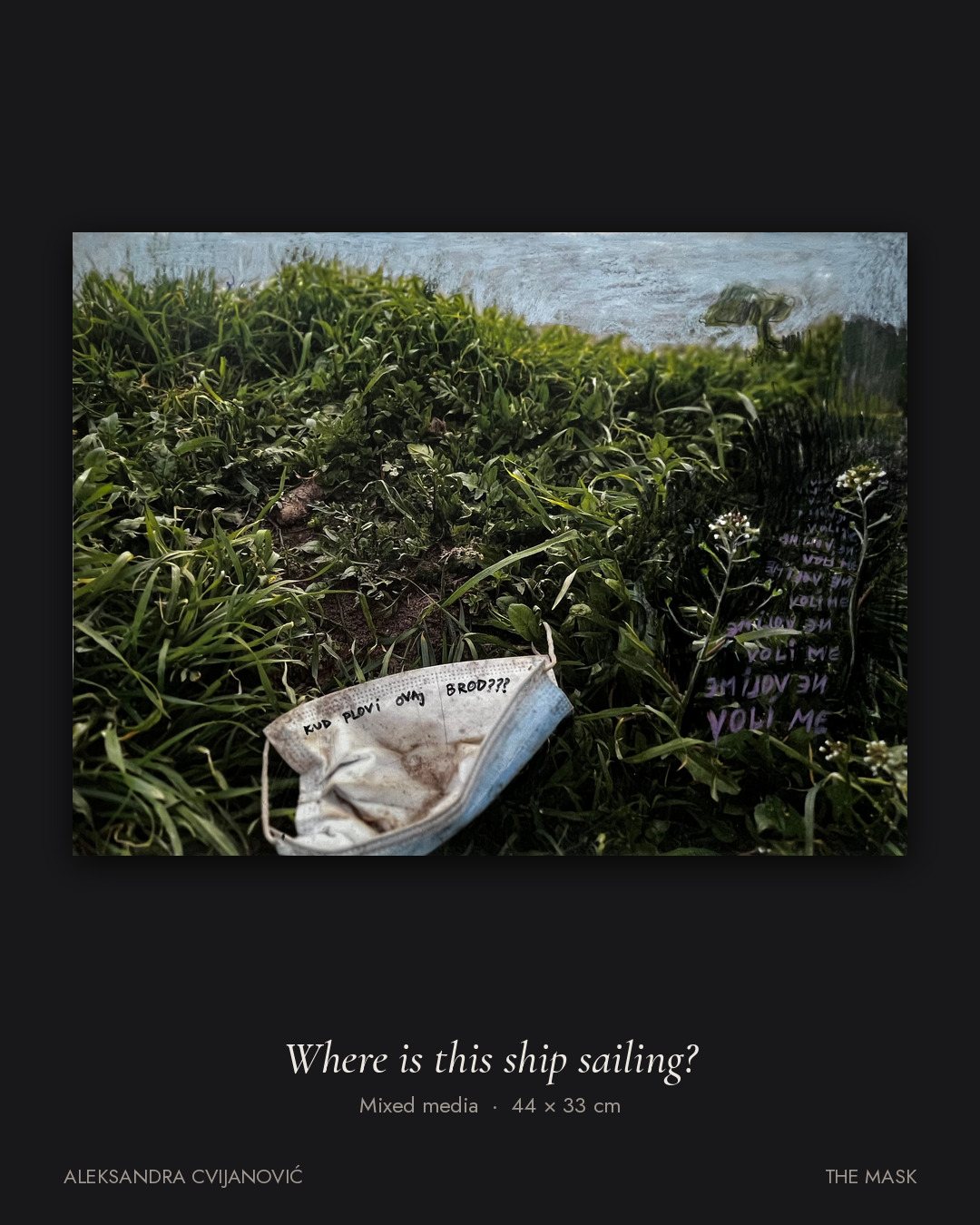
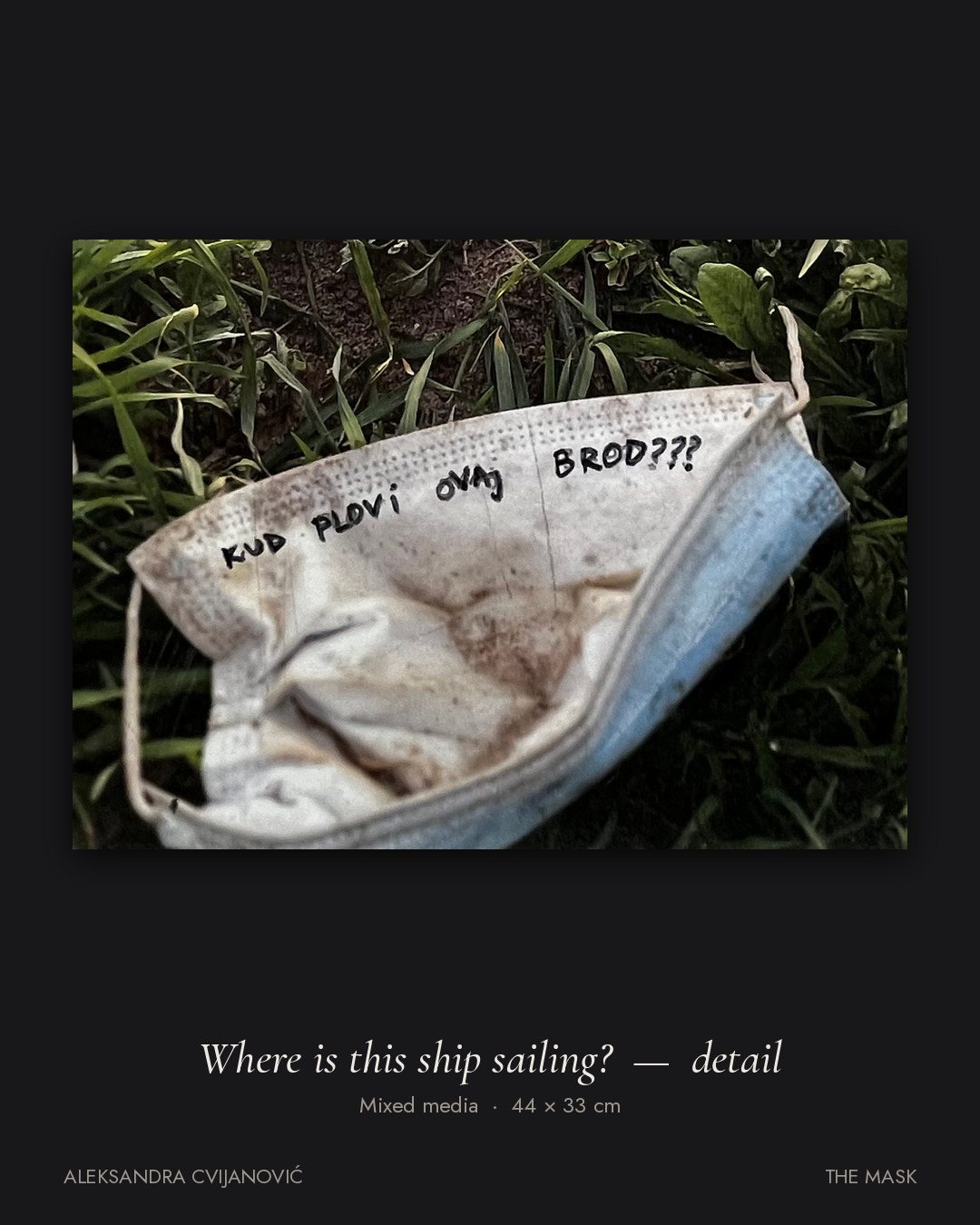
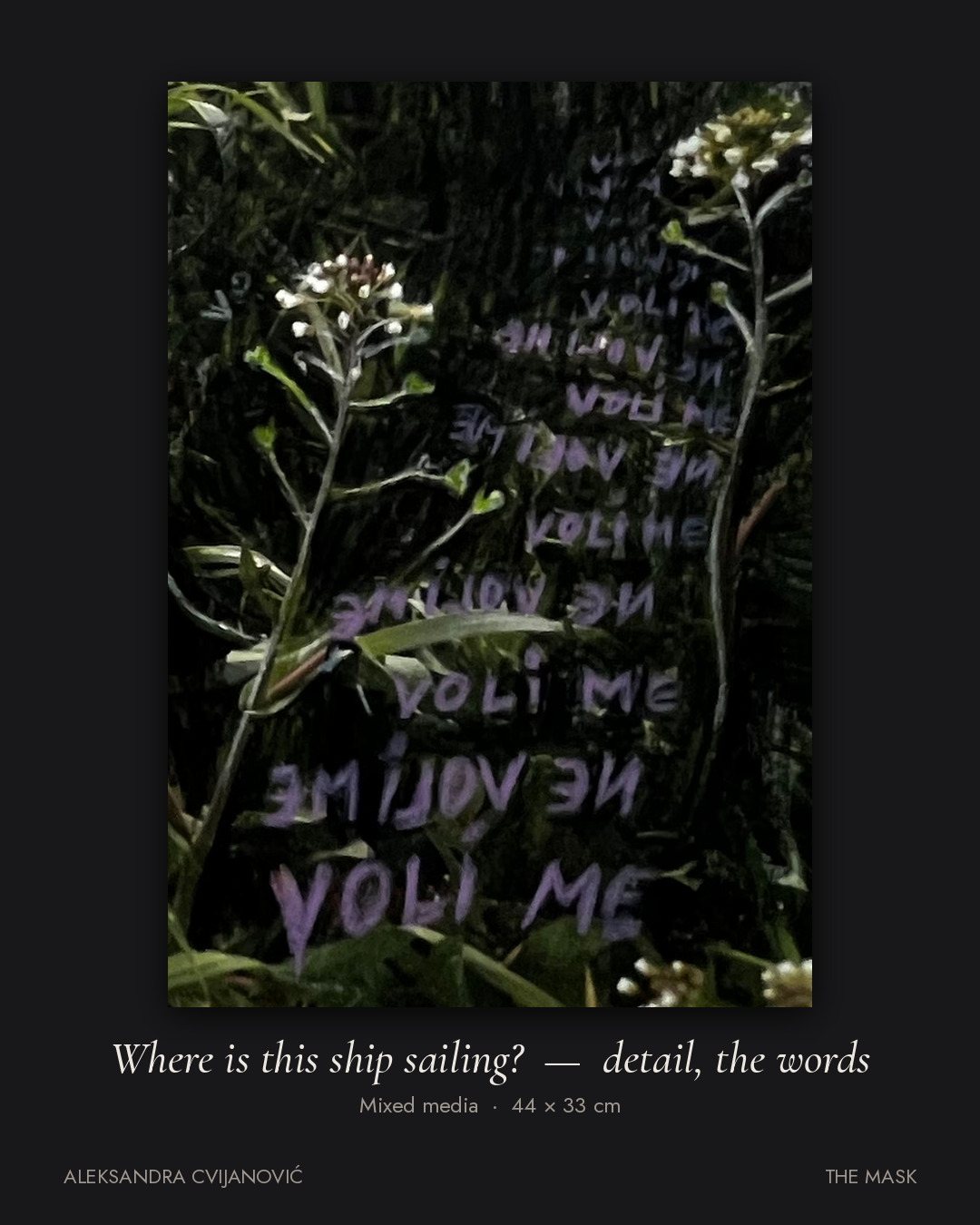
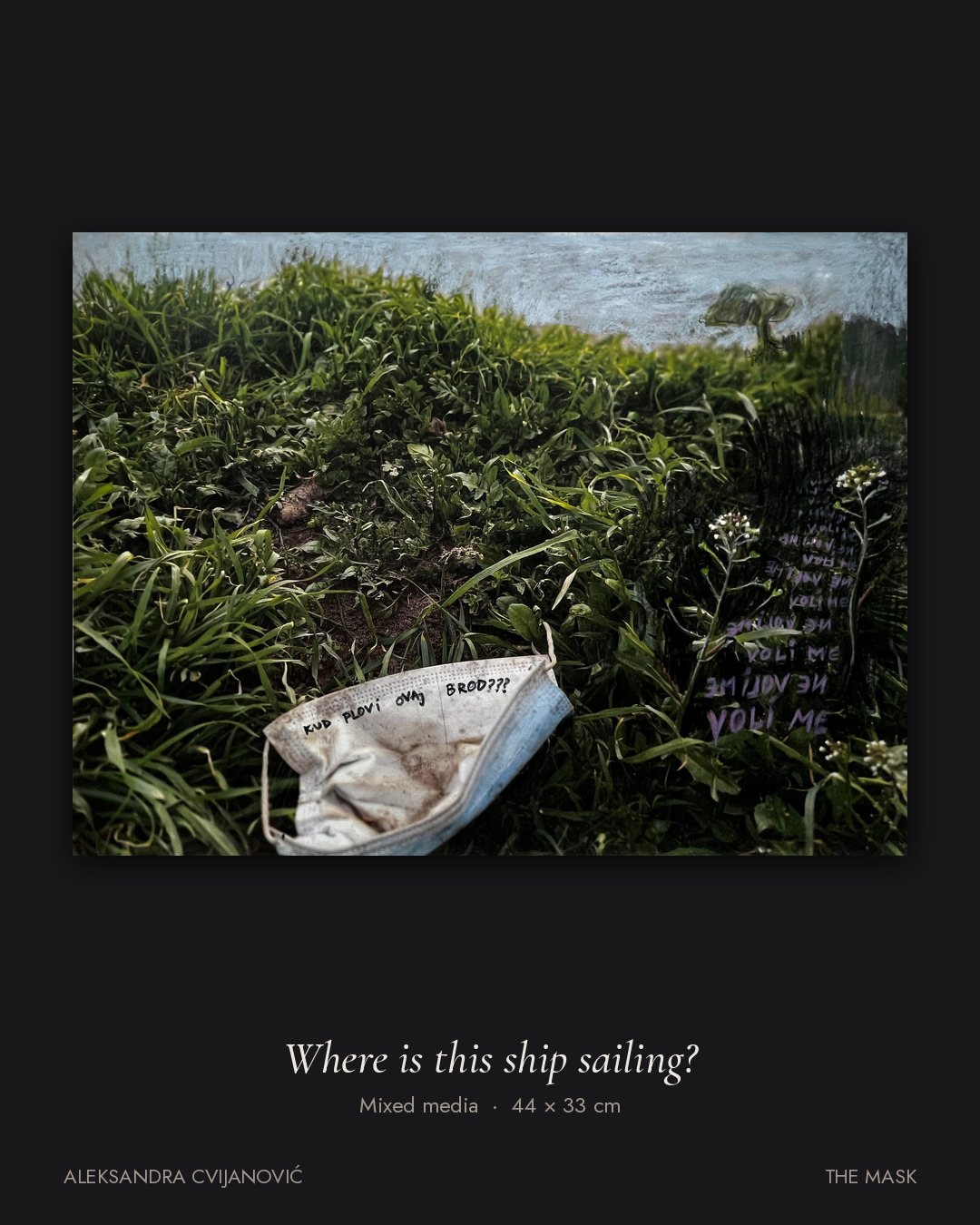
Where is this ship sailing? by Aleksandra Cvijanović: a crumpled white and blue face mask lies in tall green grass under a pale painted sky. The words "Kud plovi ovaj brod???" are written across the mask, and lilac lettering runs down the dark grass on the right.Close-up of the mask: stained white fabric with a blue edge and a loose ear loop, with "Kud plovi ovaj brod???" handwritten in black across the top.Close-up of the right side of the work: small white wildflowers on thin stems over dark grass, with the words "voli me" and "ne voli me" painted in lilac line after line, some of them mirrored.

Where is this ship sailing?

A discarded mask lies in the long grass like a small boat run aground. Across it, in black marker, the question that gives the work its title, in Serbian: "Kud plovi ovaj brod???" Beside it, in lilac paint, a few words repeat down the dark grass: "voli me, ne voli me". Loves me, loves me not, the old game of pulling petals from a flower.

Like every work in The Mask, it starts from a scene of an abandoned mask and is finished with acrylic detail. An object made to protect us, left behind to drift. Where is it going, and who will pick it up?

Where is this ship sailing?, from The Mask. Mixed media, 44 × 33 cm.

For inquiries: cvijanovic.aleksart@gmail.com · cvijanovicaleks.art

Reel: What do we throw away?

What do we throw away?

Twelve landscapes made from discarded masks: dunes, mountain peaks, a forest, a road into the night. The Mask, mixed media by Aleksandra Cvijanović.

For inquiries: cvijanovic.aleksart@gmail.com · cvijanovicaleks.art

Reel: a year in under forty seconds

A year in under forty seconds.

Twelve months of The Calendar, each followed by the one day painted on its own: the eye of 29 January, the sweets of February, a face in March, all the way to the golden trees of December.

The Calendar, acrylic on canvas. See The Calendar in person at World Art Dubai, 19–22 November, Dubai World Trade Centre, stand OB04.
For inquiries: cvijanovic.aleksart@gmail.com · cvijanovicaleks.art

The Mask: the whole cycle

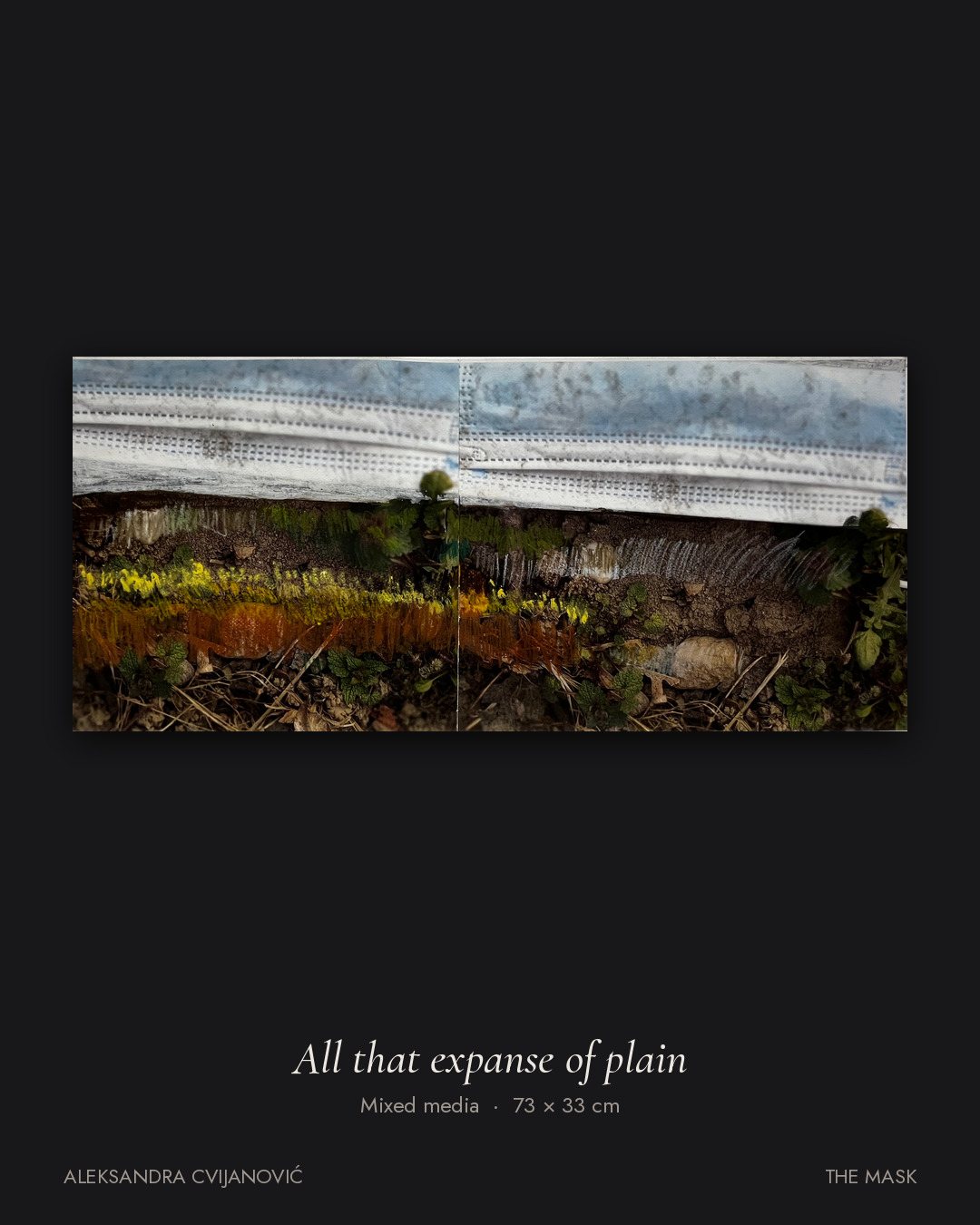
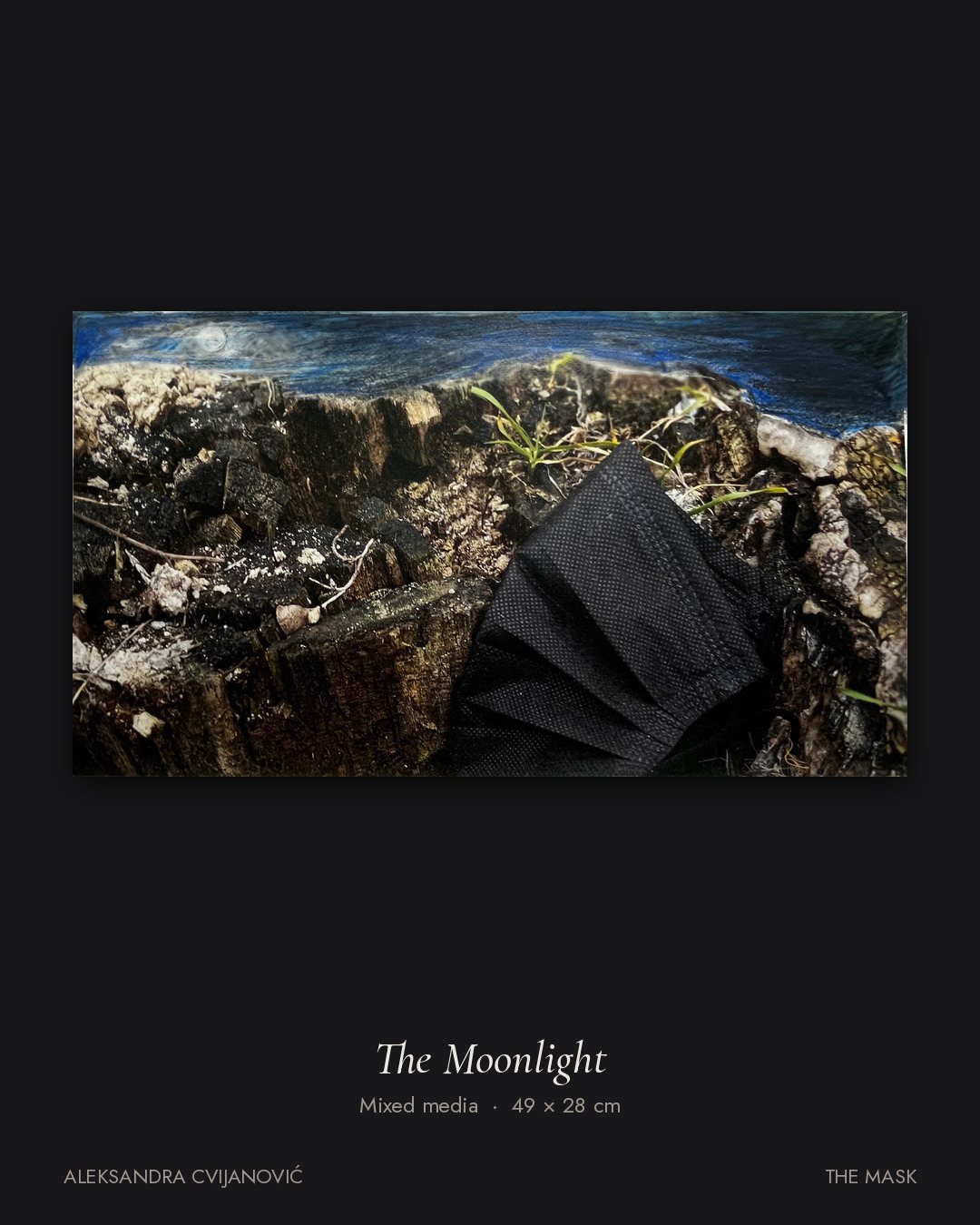
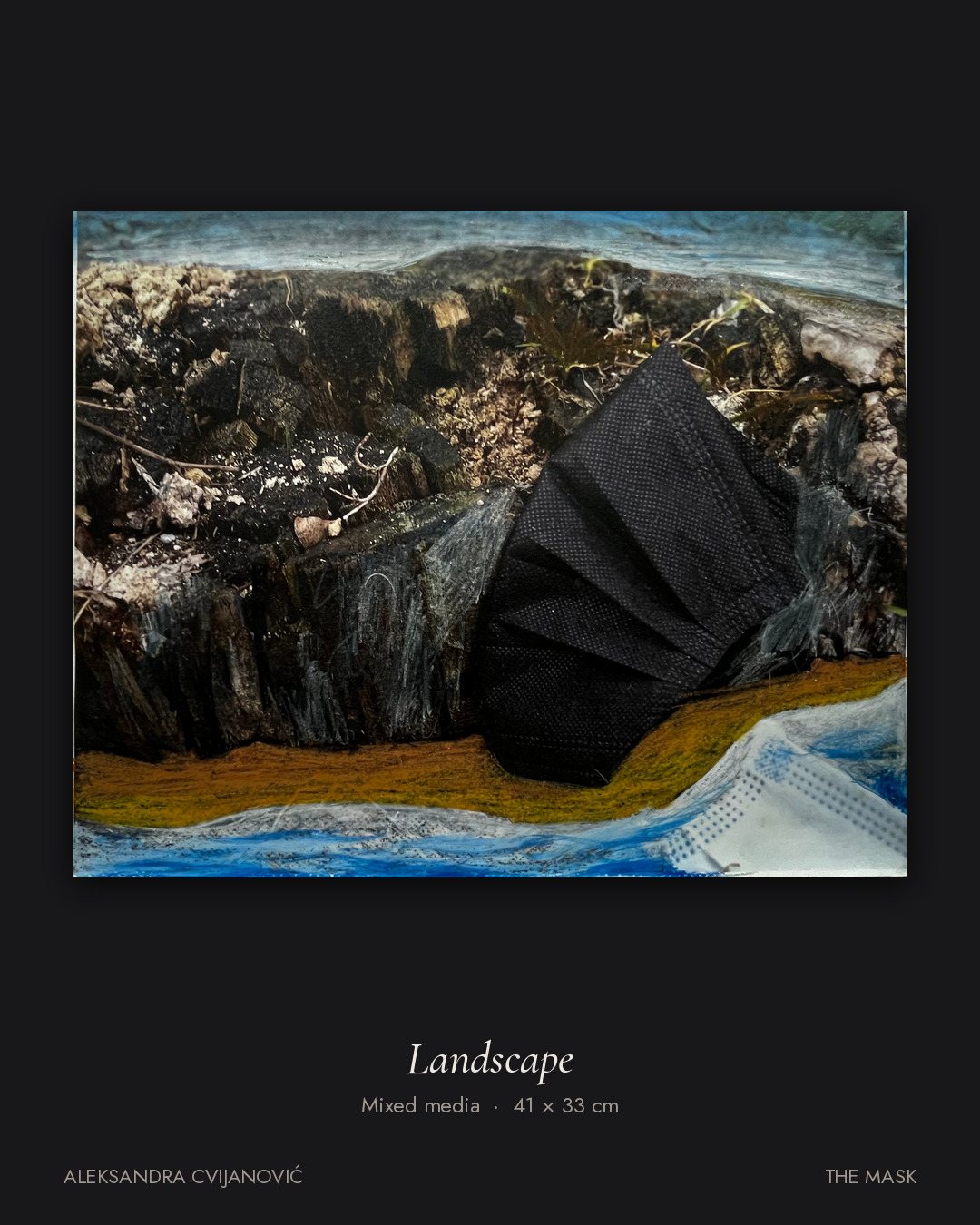
Title card: The Mask, a cycle by Aleksandra Cvijanović, over a detail of a mask shaped into snowy peaks under a night sky.Text slide introducing The Mask: from sacred relic to symbol of neglect.Where is this ship sailing? A discarded mask lies in tall green grass like a stranded boat, with handwritten words beside it.All that expanse of plain: a long mask stretched across the top of a wide field of grass and wildflowers.Dunes: the pleats of a blue mask fold down into golden hills.Landscape: a crumpled mask forms the sky above a dark valley with a winding white path.The Forest: masks tied around the trunks of bare winter trees.Perspective #1 and #2: two masks laid flat become roads with white lane markings vanishing into the dark.Landscape: a black mask rises like a cliff beside dark earth and a green river bank.The peaks of Kilimanjaro: a white mask folded into snowy mountain peaks under a starry night sky.The Moonlight: a black mask sinks into dark rocky ground under a moonlit sky.Landscape: a black mask in a rocky gorge above a river of orange and blue.Landscape: a black mask shaped like great wings above a small white village.

The Mask. A cycle in twelve works.

For thousands of years the mask has stood between the material and the spiritual, from African tribal ceremony to the theatre of ancient Greece. The pandemic gave it a darker afterlife: millions of discarded masks left in streets, parks, rivers and oceans.

In this cycle, discarded masks become landscapes. Their folds turn into mountain ridges and dunes, a road running into the dark, a forest at dusk, all finished with acrylic detail. Every work asks the same quiet question: what do we throw away, and what does it cost the world around us? Mixed media.

For inquiries: cvijanovic.aleksart@gmail.com · cvijanovicaleks.art

The Calendar: twelve months

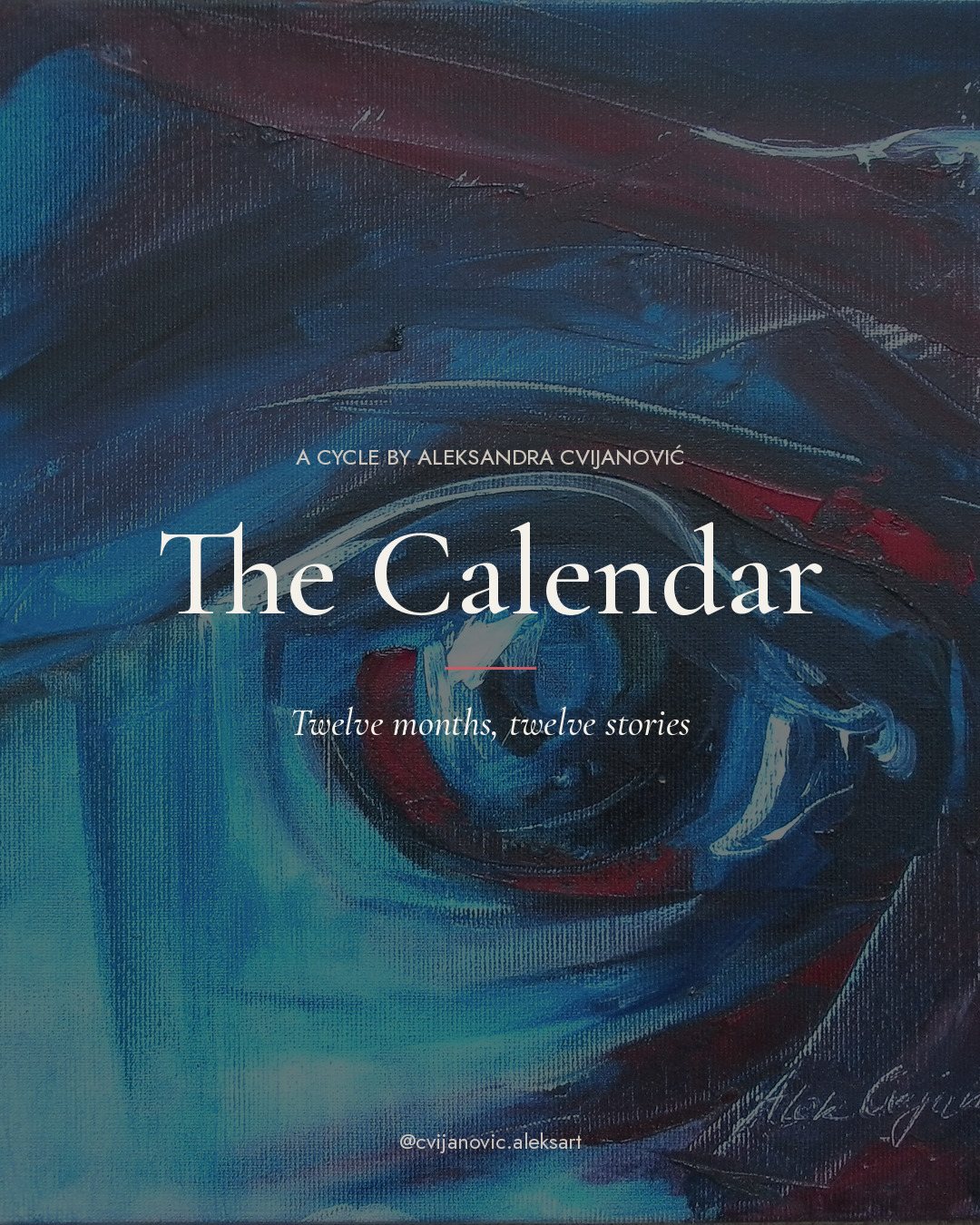
Title card: The Calendar, a cycle by Aleksandra Cvijanović, over a painted blue eye.Grid of the twelve Calendar canvases, January to December.Text slide introducing The Calendar: one year, painted day by day.January: a large white canvas covered in rows of small square paintings, one for each day of January.February: a large white canvas covered in rows of small square paintings, one for each day of February.March: a large white canvas covered in rows of small square paintings, one for each day of March.April: a large white canvas covered in rows of small square paintings, one for each day of April.May: a large white canvas covered in rows of small square paintings, one for each day of May.June: a large white canvas covered in rows of small square paintings, one for each day of June.July: a large white canvas covered in rows of small square paintings, one for each day of July.August: a large white canvas covered in rows of small square paintings, one for each day of August.September: a large white canvas covered in rows of small square paintings, one for each day of September.October: a large white canvas covered in rows of small square paintings, one for each day of October.November: a large white canvas covered in rows of small square paintings, one for each day of November.December: a large white canvas covered in rows of small square paintings, one for each day of December.

The Calendar. One year, painted day by day.

Twelve canvases, one for every month. Each is built from small daily paintings, and together they read like a diary: sweets in February, faces in March, maps of the city in April, the white of hospital corridors in May, the alphabet in November, holiday cards in December. Hopes, disruptions and small joys, recorded as they came.

From every month one day stands on its own, painted separately at 30 × 30 cm. Acrylic on canvas, 120 × 100 cm each.

See The Calendar in person at World Art Dubai, 19–22 November, Dubai World Trade Centre, stand OB04.
For inquiries: cvijanovic.aleksart@gmail.com · cvijanovicaleks.art